After I Took My Assigned First-Class Seat, an Influential Executive Refused to Sit Beside Me and Told the Crew to Move “Him” or Risk Losing Her Company’s Business—Even Though We Had Paid for the Same Cabin, Her Discomfort Somehow Became Everyone Else’s Problem the Moment She Saw a Black Man in the Seat Next to Hers
The woman assigned to 3C did not ask me to move.
She asked the flight attendant to move me.
That distinction mattered.
I had been in seat 3D for maybe six minutes.
Long enough to put my backpack under the seat in front of me.
Long enough to answer a text from my daughter.
Long enough to wonder whether spending the extra money for first class had been unnecessary.
Then Victoria Hale entered the cabin.
I didn’t know her name yet.
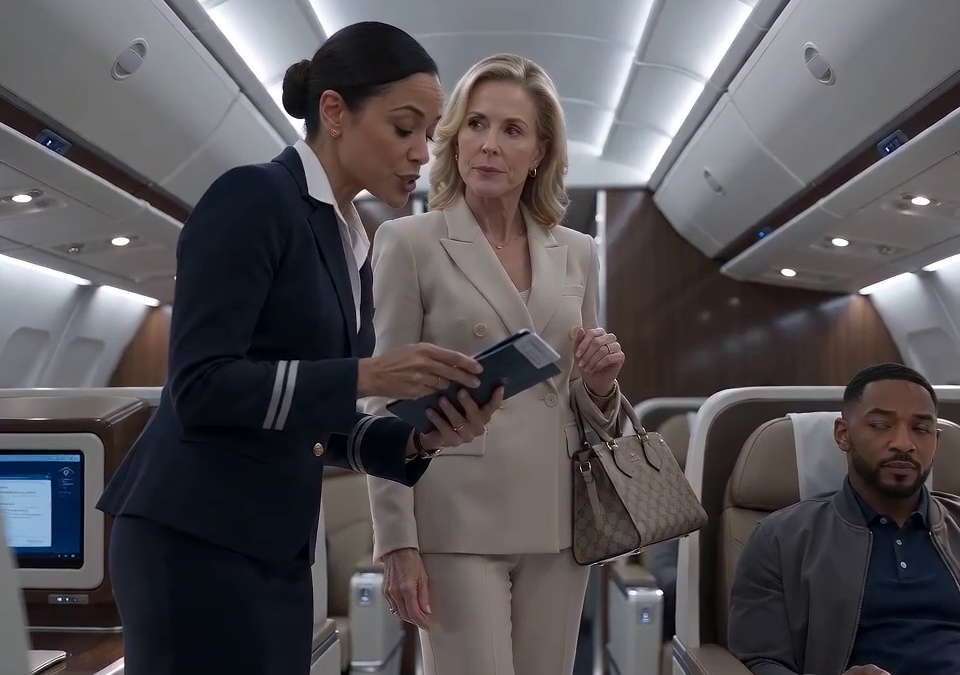
I noticed only the cream-colored suit, the structured leather handbag and the younger woman following her while balancing a laptop case and two phones.
Victoria stopped beside my row.
I stood.
“Window?”
She looked at me.
Not rudely at first.
Just long enough that I wondered whether I had something on my shirt.
Then she looked at the seat number above us.
3C.
My seat was 3D.
“Excuse me,” I said, stepping partly into the aisle. “I’ll let you in.”
She didn’t move toward the window.
Instead, she looked behind me.
The lead flight attendant was helping another passenger place a bag in the overhead compartment.
“Excuse me.”
The attendant turned.
“Yes, ma’am?”
“Is there another arrangement?”
I remained standing.
The flight attendant came toward us.
Her badge said MONICA.
She checked Victoria’s boarding pass.
Then mine.
“Ms. Hale, you have 3C.”
She gestured toward the window.
“Mr. Reed is 3D.”
Victoria smiled.
“I can see that.”
Monica waited.
“Is there an issue with the seat?”
Victoria looked directly at me.
Then back at Monica.
“I don’t share premium rows like this.”
For perhaps two seconds, Monica’s expression did not change.
Then:
“I’m sorry. I’m not sure what you mean.”
Victoria lowered her voice.
Not enough.
“My company purchases a significant amount of travel through this airline.”
The younger woman behind her shifted her weight.
I could see embarrassment moving across her face before she lowered her eyes.
Victoria continued.
“I’m asking you to make an adjustment.”
Monica looked at me.
Then at the seat map on her handheld device.
“Mr. Reed has a confirmed ticket in 3D.”
“I’m sure he does.”
The man standing behind us with a roller bag sighed quietly.
Passengers were still trying to board.
Victoria looked toward the growing line.
Then back at Monica.
“I’d rather not make this complicated.”
Neither would I.
I had been traveling since five that morning.
The flight from Boston to San Francisco would take more than six hours.
I had booked first class because of a deal through my credit card and because I had spent the previous three days standing on concrete floors at a trade show.
I owned a small commercial lighting business outside Providence.
Nothing glamorous.
Twelve employees.
Warehouse space behind a plumbing supplier.
Most weeks involved purchase orders, payroll and customers asking why something that had taken eight weeks to manufacture overseas could not somehow be delivered by Friday.
The trade show had been good.
My feet hurt.
I wanted a quiet flight.
That was all.
I had no title anyone aboard the aircraft would recognize.
No secret relationship with the airline.
No powerful relative.
No expensive membership card tucked into my wallet waiting for a dramatic reveal.
Just a ticket.
First class.
Seat 3D.
Apparently that had become insufficient evidence.
Monica said:
“I can see whether another first-class passenger is willing to switch.”
Victoria’s mouth tightened.
“I’m not asking you to inconvenience another premium passenger.”
The words landed slowly.
I looked at her.
Monica did too.
Victoria realized what she had implied.
Or perhaps she didn’t care.
“I’m asking you to handle this.”
Monica’s face changed.
“How?”
Victoria exhaled.
Then she said the sentence everyone had been waiting for her not to say.
“They will move him, or your company can lose the comfort of our business.”
Not:
Could he move?
Not:
Can you help me?
Move him.
The man with the suitcase behind us looked down.
Someone in row four stared openly.
The younger woman traveling with Victoria closed her eyes for half a second.
I sat down.
Victoria looked at me.
I fastened the seat belt.
“You don’t need to move me to solve her discomfort.”
She laughed once.
“You are making this unnecessarily difficult.”
“I haven’t asked anyone for anything.”
“You know exactly what you’re doing.”
That interested me.
“What am I doing?”
“Making a scene.”
I looked around.
“I was sitting.”
She turned away.
That was my first useful moment of the day.
Not triumphant.
Just clarifying.
I had spent much of my life learning how quickly a Black person’s refusal to cooperate with someone else’s discomfort can be described as aggression.
I knew the script.
Stay calm.
Keep your hands visible.
Speak slowly.
Do not give anyone a convenient adjective.
But getting older had taught me something else.
Calm did not have to mean accommodating.
Monica asked Victoria:
“Are you requesting that Mr. Reed be moved because you don’t want to sit beside him?”
Victoria frowned.
“I’m requesting appropriate service.”
“That wasn’t my question.”
A small silence followed.
Victoria looked at Monica’s name badge.
“I assume you have a supervisor.”
“Yes.”
“Good.”
Monica stepped aside.
She spoke quietly into the phone near the galley.
Victoria looked at me again.
“If you simply moved, everyone could continue boarding.”
“Where?”
“What?”
“Where should I move?”
She gestured toward the rear of the aircraft.
“There are other seats.”
“In first class?”
Her jaw tightened.
“I don’t know the seat map.”
“You seem certain there are options.”
“This is childish.”
I said nothing.
That frustrated her.
She was accustomed to arguments she could dominate.
Silence offered her nothing to push against.
The younger woman behind her finally whispered:
“Victoria, maybe we should just sit down.”
Victoria turned.
“Nina.”
“I’m just saying we’re holding boarding.”
“You do not need to manage me.”
Nina’s face reddened.
“No.”
Victoria returned her attention to me.
I looked away.
The gate supervisor arrived less than two minutes later.
His name was Eric Morales.
Mid-forties.
Glasses.
Tablet in hand.
The expression of someone who had been called onto airplanes for every possible reason and had stopped being surprised years earlier.
“What seems to be the issue?”
Victoria answered first.
“I requested a seating adjustment.”
Eric checked her boarding pass.
Then mine.
“Ms. Hale, 3C. Mr. Reed, 3D.”
“Yes.”
He looked at Monica.
“Duplicate?”
“No.”
“Equipment change?”
“No.”
Eric looked back at Victoria.
“What adjustment are you asking for?”
“I would like another arrangement.”
“We can look for another available seat for you.”
Victoria stared.
“For me?”
“Yes.”
“I’m not the issue.”
Eric’s voice remained completely neutral.
“Mr. Reed hasn’t requested a change.”
“My company has one of your major corporate travel accounts.”
“I understand.”
“Do you?”
“Yes.”
His answer was so ordinary that it seemed to disturb her.
Victoria leaned closer.
“Halcyon Medical spends more than four million dollars a year on employee travel.”
Nina looked down again.
Eric nodded.
“I don’t manage corporate accounts.”
“You work for the airline.”
“I do.”
“Then you understand what losing an account like ours means.”
Eric held her gaze.
“I understand you have a confirmed seat in 3C.”
The man in row two covered his mouth as if hiding a smile.
Victoria noticed.
Her cheeks colored.
“This is unbelievable.”
Eric continued.
“If you prefer not to occupy 3C, I can check later flights and other seating options.”
“Why should I move?”
“Because you are the passenger requesting a different arrangement.”
That sentence changed the atmosphere.
It was so obvious nobody had said it yet.
Victoria looked at me.
For a moment, I wondered whether she would finally sit.
She didn’t.
“I will not spend six hours beside someone when I have specifically requested otherwise.”
Eric nodded.
“Then we can rebook you.”
She laughed.
An actual laugh.
“You’re willing to delay one of your largest clients over this?”
“I’m trying not to delay the flight.”
She looked toward Nina.
“Get our bags.”
Nina didn’t move.
Victoria’s voice became sharper.
“Nina.”
The young woman swallowed.
“I need to be in San Francisco tonight.”
“So do I.”
“The supplier review is at eight.”
“I know.”
“If we take a later flight, we might miss it.”
Victoria stared.
Nina looked terrified.
Not physically.
Professionally.
The fear of an employee who has spent years reading one person’s moods because her paycheck depends on it.
“I can stay on this flight,” Nina said.
Victoria went completely still.
“You work for me.”
Nina’s hands tightened around the laptop strap.
“I work for Halcyon.”
The cabin was silent again.
That sentence did more than anything I could have said.
Victoria’s problem had never been my seat.
It was control.
Control over Monica.
Control over Eric.
Control over me.
And now, unexpectedly, control over Nina.
Eric said:
“Ms. Hale, I need your decision.”
Victoria collected her handbag.
“You’ll all regret how this was handled.”
Nobody responded.
She walked toward the aircraft door.
Nina remained.
I watched her go.
Part of me wanted to feel victorious.
I didn’t.
Mostly I felt tired.
Boarding resumed.
Passengers shuffled past.
A man put his roller bag in the wrong bin.
A child asked how long until takeoff.
Normal life returned almost immediately.
Monica came back to me.
“Mr. Reed.”
“Yes?”
“I apologize.”
I nodded.
She continued.
“I should have made it clear from the beginning that your seat wasn’t negotiable because another passenger was uncomfortable.”
That surprised me.
Not the apology.
The specificity.
“Thank you.”
She looked embarrassed.
“I hesitated because of the corporate-account comment.”
“I noticed.”
“I’m not proud of that.”
“I understand.”
She frowned slightly.
“You shouldn’t have to understand.”
Fair point.
“Still.”
She nodded.
Then returned to work.
Nina eventually moved into an open first-class seat in row five.
Before she did, she stopped beside me.
“I’m sorry.”
“You didn’t ask me to move.”
“No.”
She glanced toward the door.
“But I’ve watched her do smaller versions of this for two years.”
I looked at her.
“What does smaller mean?”
Her mouth tightened.
“Hotel staff.”
“Drivers.”
“Restaurant servers.”
“Junior employees.”
“People she thinks can’t say no.”
That last part stayed with me.
“She thinks I can’t say no either.”
“Can you?”
Nina looked toward the empty aircraft door.
“I guess I just did.”
Then she went to her seat.
The flight departed fourteen minutes late.
No security escort.
No public announcement.
No dramatic applause.
Victoria Hale simply was not aboard.
That was enough.
After takeoff, I opened my laptop.
Tried to answer email.
Couldn’t focus.
Eventually I closed it.
Monica brought dinner.
Asked whether I wanted red wine.
I said yes.
Halfway through the meal, Nina passed my row on the way to the restroom.
When she returned, she paused.
“Can I ask you something?”
“Sure.”
“Why didn’t you move?”
The question did not offend me.
She seemed genuinely curious.
“I paid for the seat.”
“I know.”
“That’s mostly it.”
She waited.
I sighed.
“And because people who ask you to move for no legitimate reason usually learn something when you do.”
“What?”
“That they were right to ask.”
Nina nodded slowly.
Then returned to row five.
I didn’t know she opened her laptop after that.
I learned later.
While we crossed the Midwest, Nina wrote a twelve-page account of the previous eighteen months working under Victoria.
Not about me alone.
Travel incidents.
Vendor meetings.
Comments about employees.
Threats.
A pattern of using Halcyon’s buying power as personal leverage.
The incident on the airplane became the moment she could no longer explain each event individually.
I did not see that document.
Not then.
I landed in San Francisco shortly after ten.
My checked bag arrived.
I picked up a rental car.
Drove to a hotel near the convention center.
The next morning, I went to breakfast at seven.
At 7:18, Nina walked into the restaurant.
I almost didn’t recognize her without the tension in her face.
She saw me.
Hesitated.
Then came over.
“Mr. Reed?”
“Marcus.”
“Marcus.”
She asked if she could sit.
I nodded.
She ordered coffee.
For a while, we talked about ordinary things.
She had worked at Halcyon for three years.
Two directly for Victoria.
I told her about my lighting business.
She laughed when I explained that half my job involved convincing contractors that lead times were not a personal insult.
Then she said:
“I sent something last night.”
I waited.
“To our ethics office.”
“What?”
“A report.”
“About the flight?”
“About a lot of things.”
I put down my coffee.
“Nina, you don’t owe me that.”
“I know.”
That mattered.
“I wasn’t doing it for you.”
“Good.”
She smiled weakly.
“I mean—partly. But mostly I realized I was becoming the person who explained her behavior to everyone else.”
That sounded familiar.
People around power often perform unpaid translation.
She didn’t mean it.
She’s under pressure.
That’s just how she is.
You know how important the account is.
The words change.
The function doesn’t.
“What happens now?” I asked.
“I don’t know.”
“Are you worried?”
“Yes.”
She looked down at her coffee.
“Very.”
I almost offered reassurance.
Then stopped.
She did not need a stranger promising consequences would be painless.
“They may investigate.”
“Yes.”
“She may be angry.”
“Definitely.”
“You could still be glad you wrote it.”
Nina looked up.
“I am.”
That was enough.
We parted after breakfast.
I returned to Rhode Island two days later.
My wife, Denise, picked me up.
She listened to the story while we drove home.
At one point she said:
“You didn’t call me.”
“What would you have done?”
“Been furious from two thousand miles away.”
“That seemed inefficient.”
She glared at me.
I laughed.
Then she reached across the console and squeezed my hand.
“You okay?”
I thought about it.
“Yes.”
Mostly.
Public humiliation leaves a residue.
Even when you “win.”
Especially when people describe your calmness afterward as strength.
Sometimes you were calm because you knew anger would be judged differently coming from you.
That is not the same thing as feeling untouched.
A week later, the airline contacted me.
Not because I had demanded an investigation.
Monica had filed an incident report.
Eric had too.
The airline apologized.
They refunded part of my fare.
I told them the money mattered less than how the crew handled future pressure.
The customer-relations manager said:
“That’s part of the review.”
Fine.
I did not ask what happened to Victoria’s corporate account.
I genuinely did not care.
Two weeks later, Nina emailed.
Subject:
THANK YOU.
The message was short.
The company had opened an internal investigation.
She had been temporarily moved to another reporting line.
That was all she could say.
I wrote back:
You don’t owe me thanks. Take care of yourself.
Three months passed.
Then another email.
This one from Halcyon Medical’s general counsel.
Formal.
Careful.
It acknowledged that I had been affected by conduct involving one of their executives while traveling.
It apologized.
It did not describe personnel decisions.
I expected nothing else.
But enclosed was one sentence I read twice:
Halcyon does not consider customer, vendor, employee, or travel-partner relationships to be personal leverage belonging to any individual executive.
That was the real issue.
Influence had become identity.
Victoria did not merely have access to power.
She had begun treating power as permission.
I never learned every detail of what happened internally.
Nina eventually told me she transferred to another division.
Victoria’s title disappeared from the company website months later.
Maybe she resigned.
Maybe she was dismissed.
Maybe the change had nothing to do with the flight alone.
Real organizations are more complicated than internet stories.
I did not need a dramatic ending.
Mine had happened in row three.
Someone had looked at a Black man sitting in a seat he paid for and decided his presence was negotiable.
For once, the people around him decided it wasn’t.
Six months later, I flew to Chicago.
Economy this time.
Seat 18F.
Middle-aged woman beside me.
College kid in the aisle.
Nobody cared who anyone was.
Halfway through the flight, the woman asked if I minded letting her out for the restroom.
I stood.
She returned.
I sat back down.
That was what moving for another passenger was supposed to look like.
A request.
A reason.
A choice.
Not a hierarchy disguised as customer service.
I smiled to myself.
Then went back to my book.