On the Night My Husband of 38 Years Died, His Family Told Me to Pack My Bags, Said I Was Only His “Second Wife” Who Had Never Built Anything With Him, and Suggested Assisted Living—While the Stepson I Had Raised Since He Was Twelve Stood There and Let Them Reduce My Entire Marriage to “You Were Just There”
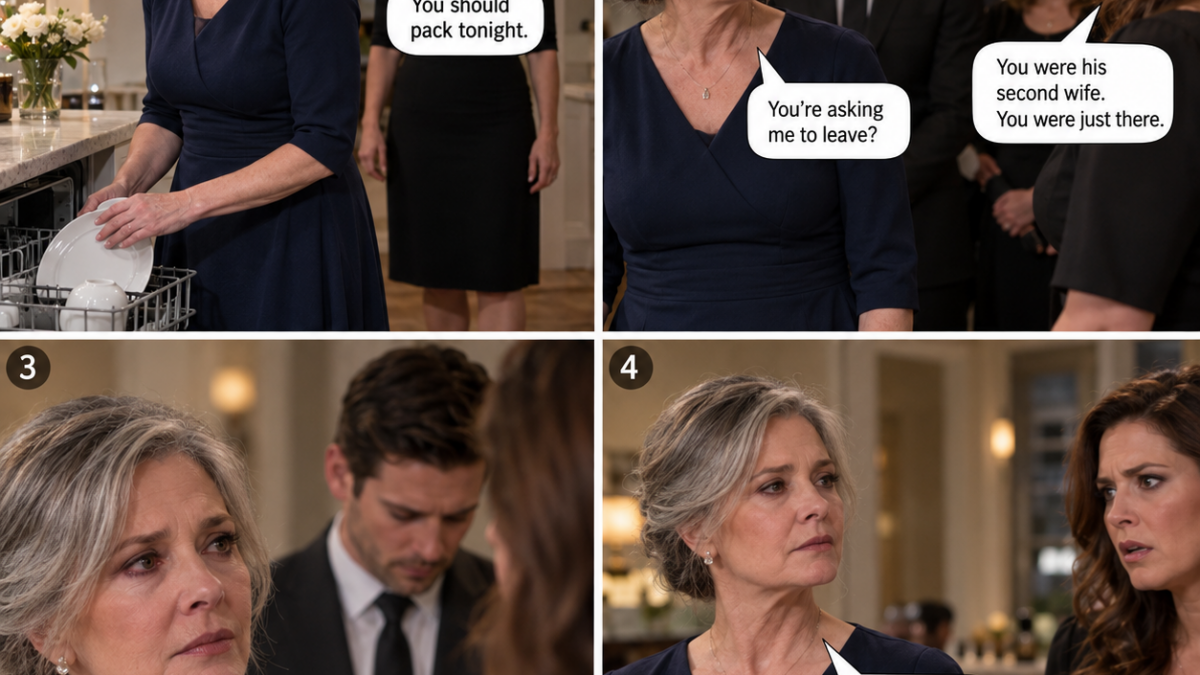
On the day my husband Richard died, I believed the worst thing I would experience was losing the man I had loved for thirty-eight years.
I was wrong.
The funeral was dignified.
Exactly the kind of service Richard would have wanted.
His children spoke.
Marcus gave a eulogy.
Sarah read a poem.
Even Patricia, Richard’s former wife, managed to say something kind.
I sat in the front row wearing the navy dress Richard had always said brought out my eyes.
People told me how devoted I had been during the final months of his illness.
They were right.
I had cared for him until the end.
But most of those people knew only the public version of our marriage.
They knew Richard as the businessman.
The provider.
The successful man with a complicated family.
I was Alberta.
The second wife.
The woman standing slightly behind him in photographs.
I had never minded that.
Not until Richard was gone.
The reception was held at the house we had shared for fifteen years.
Guests moved through rooms filled with our life together.
Photo albums.
Furniture.
Paintings.
I watched distant relatives looking around in ways that felt less like mourning and more like inventory.
Sarah’s husband asked questions about Richard’s business.
Marcus’s wife commented repeatedly on the value of the house.
But Cynthia watched me most closely.
She was married to David, Richard’s youngest son.
David had been twelve when I entered his life.
I had attended his school events.
Helped with homework.
Sat beside him when he was sick.
Taught him to drive.
I had never thought of those things as favors.
I loved him.
Cynthia had never seen it that way.
From the beginning, she seemed convinced I had married Richard for money.
A gold digger.
A woman occupying space that should have belonged to his “real” family.
She had no idea what Richard’s money actually looked like.
Or mine.
The last guest left around eight-thirty.
I went into the kitchen and began loading the dishwasher.
My hands were shaking, so I focused on plates.
Then Cynthia entered.
“Well, that’s over with.”
I thanked her for helping with the funeral.
She told me to stop pretending.
Then I noticed who stood behind her.
David.
Marcus.
Sarah.
A family tribunal.
“We need to talk about practical matters,” Cynthia said.
“The house. Richard’s assets. The business.”
She said she and the others had discussed it.
They thought it would be best if I found somewhere else to live.
For a moment, I truly thought grief had distorted the words.
“Are you telling me to leave?”
Cynthia smiled.
Not kindly.
She said I needed to be realistic.
I was sixty-four.
The house was too much for me.
Richard had taken care of me while he was alive.
Now I needed to downsize.
Maybe a senior community.
Something “appropriate.”
Then she explained the logic.
I had never worked.
Richard had provided the house.
The lifestyle.
The security.
Everything.
That was Richard’s success.
I stood inside my own kitchen listening to someone describe my life as though I had been a dependent guest.
Marcus joined in.
There were four children.
Grandchildren.
College funds.
Retirement planning.
They needed to consider the estate responsibly.
I reminded them there was a will.
Cynthia waved the point away.
They would honor whatever small provision Richard had left me.
Then she looked at me and said:
“You were his second wife, not his business partner.”
I stayed silent.
“You didn’t build anything together.”
Then:
“You were just there.”
I felt those words more deeply than everything else she said.
Thirty-eight years.
Reduced to presence.
I looked at David.
He would not meet my eyes.
Cynthia told me to pack that night.
She and David would stay and manage the transition.
I asked where she expected me to go.
She suggested assisted living.
That was when grief began turning into something colder.
I said one word.
“Okay.”
Everyone went quiet.
“I’ll pack tonight.”
Cynthia seemed almost disappointed.
They wanted an argument.
I gave them none.
I packed two suitcases.
Nothing more.
They could keep looking at the jewelry, furniture and artwork for another few days.
Let them think those objects represented the important part of my life.
I checked into a Hampton Inn under my maiden name.
Alberta Morrison.
I paid for a week.
The hotel was anonymous.
Perfect.
The next morning, Harold Steinberg came to see me.
He had been Richard’s attorney for twenty-five years.
He had also handled my affairs for fifteen.
Nobody in Richard’s family knew that.
I explained what happened.
Harold became visibly angry when I repeated Cynthia’s words.
Then he asked:
“Do they know anything about your actual financial position?”
“No.”
Richard and I had intentionally kept it that way.
He liked being publicly viewed as the businessman.
I had no need for attention.
Harold opened his briefcase.
Everything, he reminded me, had been legally structured years earlier.
Much of the property the family assumed belonged to Richard did not.
The house, specifically, had been transferred into my ownership long ago after I provided capital during refinancing.
Richard retained occupancy rights.
Ownership was mine.
My own assets went much further than that.
I had been financially independent before meeting Richard.
My first husband died in 1995 and left me substantial investments.
Real estate.
Stocks.
Insurance.
I managed those assets quietly.
Morrison Holdings had been established in 1996.
Over the years, I bought property.
Apartment complexes.
Office buildings.
A warehouse in Soho that no one wanted when I purchased it.
Richard knew.
He respected my privacy.
His children did not.
They believed I had never worked because they had never seen me go to an office.
They had no idea investment management had been my work.
Harold asked whether I still wanted to proceed with the plans Richard and I had already discussed.
“Yes.”
The preliminary transfers could happen quickly.
The complete restructuring would take longer.
Legally, the important fact was simple.
My assets were mine.
They had been mine for years.
After Harold left, I drove past the house.
Moving trucks were already there.
Cynthia was moving in.
Not temporarily.
Permanently.
My phone buzzed.
David wrote that he hoped I had found somewhere comfortable and that Cynthia was organizing Richard’s office.
I almost laughed.
The business files they were searching for were not there.
The meaningful documents were protected elsewhere.
The next several days were quiet.
I met with my banker.
Moved accounts.
Spoke with property managers.
Reviewed renovations on the Soho building.
From the hotel business center, I handled more real financial business in three mornings than Richard’s family imagined I had done in my lifetime.
Then Harold called.
They had hired an attorney.
They wanted a formal will reading.
Monday at two.
“Are you ready?” Harold asked.
“I’ve been ready for fifteen years.”
I moved into a nicer hotel for the night before the meeting.
Not to impress anyone.
To remind myself of who I was before walking into a room full of people determined to define me.
Monday afternoon, I arrived early.
Outside the conference room, I heard them arguing.
Cynthia questioned why I needed to be there.
Marcus said I had never contributed to Richard’s estate.
They spoke about me as if I were a legal inconvenience.
At two, Harold arrived.
With him was Catherine Walsh, the attorney representing me.
Inside the conference room, the family sat together on one side.
I sat opposite them.
The will reading began.
Richard left charitable bequests first.
Then came his children.
Marcus.
Sarah.
David.
Fifty thousand dollars each.
Their disappointment was immediate.
Then Richard’s remaining estate was read.
Everything else went to me.
Properties.
Investments.
Business interests.
Personal assets.
Without restriction.
Cynthia interrupted.
She demanded clarification.
Marcus said his father would never leave them so little.
Harold confirmed the will was legal and explicit.
Then Cynthia lost control.
“She didn’t earn any of it.”
Nobody spoke.
“She never worked. She never contributed. She was just there.”
The same words.
Again.
This time they did not hurt in the same way.
I stood.
“You’re right.”
Cynthia blinked.
I explained that Richard’s modest consulting business had been his.
His reputation was his.
I had never built those things.
Confusion moved through the room.
Then Catherine opened her briefcase.
“The real question,” she said, “is what Richard actually owned.”
The first document was the house deed.
My name.
Alberta Morrison.
Cynthia went white.
The house had been transferred to me years earlier.
Richard had occupancy rights.
That was all.
Sarah said it had to be wrong.
Harold explained the refinancing.
The capital had come from me.
Marcus demanded to know where I could possibly have gotten that kind of money.
Catherine answered.
I had been financially independent before marrying Richard.
Then came Morrison Holdings.
Seventeen properties in three states.
Three Manhattan apartment complexes.
Two Boston office buildings.
The Soho building.
Recently appraised at twenty-eight million dollars.
Sarah repeated the number.
“Twenty-eight million?”
“That’s one property,” Harold said.
More documents appeared.
Accounts.
Investments.
Deeds.
The total value of my holdings was roughly forty-seven million dollars, excluding the comparatively modest assets in Richard’s estate.
The room changed.
Cynthia stared at me.
“You’re lying.”
“About which part?”
I asked politely.
“Being independent before I met Richard? Or the fact that you’ve spent the last week living in my house?”
Marcus asked why Richard had never told them.
“Because I asked him not to.”
Richard had liked being seen as the provider.
I had allowed him that image.
Privately, the reality was different.
The mortgage.
Taxes.
Insurance.
Utilities.
Those had largely come from my accounts.
His consulting income covered smaller expenses.
Cynthia began shaking.
“You let us think—”
“No.”
I interrupted.
“I let you show me who you were.”
I did not make them throw me out.
I did not make them reduce thirty-eight years of marriage to “just there.”
They had been given every chance to behave decently toward a grieving widow.
They chose otherwise.
Catherine explained that each of Richard’s children would receive exactly what the will stated.
Fifty thousand dollars.
As for the house, the people currently living there had no ownership rights.
I stood.
“You wanted me out of the way.”
I looked directly at Cynthia.
“You got me out of the way.”
Then I gave them seventy-two hours to remove their belongings.
After that, legal eviction proceedings would begin.
Cynthia suddenly remembered we were family.
I repeated the word.
“Family.”
Then I left.
Six hours later, she called.
Now she wanted to work things out “reasonably.”
I reminded her that she had thrown me out hours after Richard’s funeral.
She blamed grief.
I reminded her she had been clear enough to start dividing assets immediately.
Then she used a word she apparently thought I did not understand.
A Portuguese insult meaning bloodsucker.
She had used it before.
I told her I had understood perfectly.
Then I blocked her number.
The next day, David came to see me alone.
Without Cynthia.
He apologized.
He said Cynthia had gone too far.
I reminded him that he had stood there.
That I had helped raise him from age twelve.
That he had watched a grieving woman be pushed out of her home.
David admitted he had expected Richard’s money to provide for them.
Now that he knew the truth, he was afraid.
That made his apology difficult to trust.
I gave him the same deadline.
No financial rescue.
No special treatment.
He would have to begin living with his own choices.
When the deadline came, I returned to the house.
Several cars were in the driveway.
The family had gathered.
Cynthia’s parents were there too.
They had apparently heard a version of the story where I was the villain.
I introduced myself.
Then calmly explained the legal situation.
The house belonged to me.
I had been independent before Richard.
My holdings were worth about forty-seven million dollars.
Cynthia’s parents looked at their daughter differently.
Her mother asked if she had really thrown me out on the night of Richard’s funeral.
Cynthia tried to explain.
Her parents were horrified.
They left.
That was the final collapse of Cynthia’s support.
I gave everyone twenty minutes.
Bags moved quickly after that.
Sarah.
Marcus.
David.
Cynthia stood in the living room until nearly the end.
“This isn’t over.”
“Yes,” I said. “It is.”
The final car left.
I called Harold.
“It’s done.”
“How do you feel?”
I walked through the house.
It already felt lighter.
“Free.”
Six months passed.
My life became peaceful.
Then one morning, while I was in the garden, Mercy General Hospital called.
David had been in a car accident.
He was stable.
And he had listed me as his emergency contact.
Despite everything, I went.
He was injured but alert.
Cynthia was gone.
Their marriage had fallen apart months earlier.
David told me she had admitted she married him for the lifestyle she expected.
When that disappeared, so did she.
I told him I was sorry.
He seemed surprised.
Then he finally said what he had apparently been carrying for six months.
He knew what happened that funeral night was wrong.
He knew while it was happening.
He had been angry about the inheritance.
Disappointed in Richard.
And he let Cynthia convince him I was the obstacle.
Then he reminded me of our history.
I had raised him.
Soccer games.
Homework.
Sick nights.
Driving lessons.
The ordinary things that build a family.
“I should have protected you that night.”
He began crying.
“I threw away the one person who loved me without conditions.”
I took his hand.
He said he did not expect forgiveness.
I told him what had changed in me.
That night I thought I was losing my family.
Really, I was losing an illusion.
They had valued me for what they believed I could provide.
Not because they knew me.
Now David was finally seeing me as a complete person.
And I was seeing him clearly too.
Not simply as Richard’s son.
Not simply as Cynthia’s husband.
But as someone beginning to take responsibility.
Justice and revenge were not the same.
The financial consequences had already happened.
The house was mine.
My life was mine.
Cynthia had made her choices and shown no remorse.
But David was trying.
So I agreed to try too.
Not return to the old relationship.
Build a new one.
With boundaries.
Honesty.
No rescuing.
If he wanted a place in my life, he would have to maintain that relationship himself.
He agreed.
Before I left, he asked about Marcus and Sarah.
“My door is open,” I said. “They have to decide whether to walk through it.”
Cynthia was different.
Some bridges burn because someone keeps setting them on fire.
That evening, I sat in my garden.
Marcus and Sarah had both called.
Tentative messages.
Awkward apologies.
I might call back tomorrow.
Or wait.
For the first time in decades, I was not in a hurry to make anyone else comfortable.
I had time.
Resources.
Choices.
And complete control over my own life.
The invisible woman was gone.
I finally knew exactly who I was.
And that was worth more than forty-seven million dollars.
Though the forty-seven million didn’t hurt.