At My Parents’ Family Dinner, My Dad Asked Why I’d Arrived by Taxi When the Camry He Gave Me Was Missing—and My Husband Casually Said He’d Given It to His Mother Because She “Needed It More,” Even Though He Had Never Asked Me and Wouldn’t Let Anyone Touch the Truck He Called His
My father noticed the empty driveway before he noticed I had arrived in a taxi.
He was standing on the porch of the house where I grew up, a dish towel thrown over one shoulder, checking whether my mother needed help carrying food outside.
I stepped onto the walkway with my purse tucked beneath one arm.
“Elena?”
“Hi, Dad.”
His eyes moved past me.
The taxi was already pulling away.
“Where’s the Camry?”
Before I could answer, my husband spoke from behind him.
“I gave it to Mom.”
Derek said it with a smile.
Not a guilty smile.
Not a nervous one.
The relaxed smile of someone describing a decision that had already been settled.
Dad turned around.
“You gave Carol Elena’s car?”
“She needed it more.”
That was how I learned my husband had given my car away.
Not loaned it.
Not asked whether his mother could use it temporarily.
Given it.
Saturday morning, Derek had taken my keys from the ceramic bowl beside our back door.
“Your front tires are getting low,” he said.
“I’ll have them checked.”
I was answering emails at the kitchen table.
“Thanks.”
He kissed the top of my head.
Nothing about that moment felt important.
That bothered me later.
Serious betrayals are easier to understand when they arrive dramatically.
Sometimes they happen while you are deciding whether to answer an email before breakfast.
My mother-in-law, Carol, had been without a reliable car for almost two weeks.
Her twelve-year-old Buick developed transmission problems that would cost more to repair than the car was probably worth.
Derek had been helping her.
So had his sister.
Carol was sixty-eight, independent, and deeply unhappy about needing rides.
I knew all of that.
I also knew Derek wanted to help.
What I did not know was that his solution was sitting in my parents’ driveway every night.
Or had been.
The Camry was a 2021 model.
Nothing exotic.
Nothing anyone would stare at in a parking lot.
But it mattered to me.
My father had given it to me three years earlier.
My old Civic had reached the point where every repair seemed to cost six hundred dollars and only bought another three months.
I was thirty-seven then and had just accepted a promotion requiring me to commute into Dallas three days each week.
Dad had recently sold a fishing boat he barely used.
One afternoon he called and told me to meet him at a Toyota dealership.
I assumed he wanted help buying something.
Instead, he walked me to a silver Camry.
“Happy early birthday.”
I stared at him.
“Dad.”
“I know.”
“No.”
“I already paid for it.”
“Dad.”
“You have used cars held together with optimism since college. Let me do one irresponsible parent thing before I get too old.”
He titled it in my name.
Not because Derek and I were having problems.
We weren’t.
Dad simply said, “A gift belongs to the person you give it to.”
Derek had been there when he said it.
Three years later, apparently, Derek had forgotten.
I looked at my husband on the porch.
“You gave Carol my car?”
His smile disappeared.
“Elena, come on.”
“That is not an answer.”
“Her transmission is gone.”
“I know.”
“She needs groceries. She has church. She has appointments.”
“I know all of that.”
“Then what are we arguing about?”
I almost laughed.
“My car.”
Derek lowered his voice.
“Your dad gave it to us while we were married.”
Dad spoke.
“I gave it to Elena.”
Derek looked at him.
“I know, Frank.”
“No. You just said something different.”
That was the first crack in Derek’s confidence.
He recovered quickly.
“Elena works from home several days a week.”
“I go into the office three days.”
“I can drive you.”
“You leave for job sites at six thirty.”
“We can work something out.”
I looked toward the road where my taxi had disappeared.
Apparently “we” meant everyone after Derek had already made the decision.
My mother opened the front door wider.
“Pot roast is getting cold.”
There are few stranger experiences than being furious while someone is worried about potatoes.
Dad stepped off the porch and walked toward the side of the house with his phone.
Derek exhaled.
“This is why I didn’t tell you before.”
I looked at him.
“What?”
“You’re making it bigger than it has to be.”
“You took something that belongs to me.”
“I helped my mother.”
“With my car.”
“Because you have flexibility.”
“So do you.”
He frowned.
“I need my truck.”
I waited.
He did not hear the contradiction.
Derek owned a black Ford F-150 he bought two years earlier.
He used it for his contracting work.
It carried tools.
Supplies.
Lumber occasionally.
I understood why it mattered.
But Derek treated that truck as completely personal property.
Once, my brother asked to borrow it for two hours to pick up a couch.
Derek refused because he did not like other people driving it.
When Carol asked to use it while hers was in the shop the previous year, Derek said his insurance was complicated.
Nobody accused him of being selfish.
His reasons were accepted.
My reasons, apparently, required committee review.
“You could give Carol your truck,” I said.
“That makes no sense.”
“Why?”
“I need it for work.”
“I need my car for work.”
“You can use rideshare.”
“So can Carol.”
His expression changed.
“That would get expensive.”
I stared at him.
The taxi ride to my parents’ house had cost forty-three dollars.
Apparently that expense was unreasonable for his mother and acceptable for his wife.
Dad returned.
He slipped his phone into his pocket.
No announcement.
No threat.
Nothing dramatic.
He simply washed his hands and sat down.
“Pot roast smells good.”
Mom served dinner.
Derek looked relieved.
I knew that look.
He thought Dad had decided not to get involved.
For nearly six minutes, the conversation limped around the problem.
Mom asked about my office.
Dad mentioned a neighbor replacing his fence.
Derek described a subcontractor who had ordered the wrong cabinet doors.
I moved food around my plate.
Then Derek’s phone rang.
He looked at the screen.
His face changed.
“Mom?”
Dad continued eating.
Derek pushed his chair back.
“No. I’m at Frank and Diane’s.”
Pause.
His forehead tightened.
“What do you mean?”
Another pause.
“No. That isn’t what happened.”
He looked at me.
I felt cold despite the warm dining room.
Derek stood.
“Mom, slow down.”
Carol’s voice was loud enough that we could hear the rhythm of it without understanding the words.
Then she said something clearly enough for all of us.
“Put Elena on the phone.”
Derek stopped.
I looked at Dad.
“Did you call Carol?”
He nodded.
“What did you say?”
“I asked whether you had offered her the Camry.”
Derek turned sharply.
“You called my mother?”
Dad looked at him.
“Yes.”
“Why?”
“Because you said she had Elena’s car.”
“That is between Elena and me.”
Dad nodded.
“Then Carol shouldn’t have been told Elena offered it.”
The room went quiet.
I looked at Derek.
Dad continued calmly.
“Carol said you told her Elena wanted her to have it.”
Derek’s mouth opened.
Nothing came out.
The entire situation shifted.
Until then, I had assumed Derek had made an entitled decision.
That was bad enough.
Now I understood he had constructed two versions of the same event.
To me:
His mother needed the car more.
To Carol:
I had volunteered it.
That kept him safely in the middle.
Generous son.
Reasonable husband.
Neither woman knowing what he had told the other.
His phone remained in his hand.
Carol said again, “Let me speak to Elena.”
Derek handed it to me.
“Hi, Carol.”
She sounded horrified.
“Elena, I am so sorry.”
“It’s okay.”
“No, it is not.”
I heard a car door close on her end.
“I thought you gave me this car.”
“I didn’t.”
“Derek said you two were going down to one vehicle because you work from home.”
I looked at Derek.
He stared at the floor.
“I never said that.”
“I know that now.”
Carol’s voice shook with anger.
“At first I told him absolutely not. Then he said you were the one insisting.”
That detail hurt differently.
Derek had not even needed to persuade his mother much.
He had used my imaginary generosity to overcome her objection.
“I’m bringing it back.”
“You don’t have to drive tonight.”
“Yes, I do.”
Derek stepped closer.
“Mom, keep the car tonight. We can talk tomorrow.”
She heard him.
“No.”
He closed his eyes.
“Mom.”
“I don’t take gifts from people who didn’t give them.”
That sentence landed harder than anything Dad could have said.
Carol ended the call.
I placed Derek’s phone on the table.
He sat down slowly.
Mom removed our plates even though nobody had finished eating.
Dad stood to help her.
He looked at me.
Not Derek.
Me.
“You okay?”
“No.”
He nodded.
“Fair.”
That was all.
I appreciated him for that.
Derek waited until my parents walked into the kitchen.
Then he whispered, “I can explain.”
“I hope so.”
“I didn’t lie to hurt you.”
“That is not the comforting sentence you think it is.”
He leaned forward.
“Mom was embarrassed.”
“So?”
“She feels like she’s becoming dependent on everyone.”
“I understand that.”
“I wanted to give her something stable.”
“You wanted to give her my car.”
“I thought you’d agree eventually.”
There was that word again.
Eventually.
As though consent were simply the amount of time required to wear someone down.
“Why didn’t you ask?”
He rubbed his forehead.
“Because I knew you’d say no at first.”
“And that wasn’t enough?”
“Elena.”
“No. Explain that part.”
He looked toward the kitchen.
“I didn’t want another argument.”
“So you skipped the argument and skipped my answer.”
“That’s not fair.”
“What part isn’t?”
He had no response.
Carol arrived forty minutes later.
She drove the Camry into my parents’ driveway.
Dad watched from the living-room window but stayed inside.
That mattered.
He had started the truth.
He did not try to own the outcome.
Carol came through the front door holding my keys.
Her cheeks were red.
She looked at me first.
“I’m sorry.”
“You didn’t know.”
“I should have called you.”
“Maybe.”
She nodded.
“I should have.”
Then she turned to Derek.
I had rarely seen Carol angry at her son.
“You embarrassed me.”
Derek stood.
“Mom, I was trying to help.”
“No. You were trying to look like you helped.”
His face tightened.
“That’s not true.”
“You gave me somebody else’s car.”
“I was going to work it out with Elena.”
“After?”
“Yes.”
Carol stared at him.
“Then you didn’t give me a car. You gave me a problem you hoped Elena would solve.”
Nobody spoke.
Carol handed me the keys.
Derek looked at them.
For the first time that night, he seemed to understand that getting the Camry back did not reset anything.
He and I drove home separately.
I took my car.
He took his truck.
The symbolism was almost embarrassing.
At home, Derek followed me into the kitchen.
“I know I screwed up.”
“Yes.”
“What do you want me to do?”
I took off my coat.
“That question is too late.”
He looked confused.
“What does that mean?”
“It means the problem isn’t that Carol had my car for eight hours.”
“I know.”
“Do you?”
“Yes.”
I sat down at the kitchen table.
“Then tell me what the problem is.”
Derek stood across from me.
For a while he said nothing.
Then:
“I lied.”
“That’s one part.”
“I made a decision without you.”
“Another part.”
He became frustrated.
“What answer are you looking for?”
“I’m not looking for an answer.”
“Then what?”
“I want to know whether you understand why your truck was never one of the possible solutions.”
He looked at me.
“That truck is how I make money.”
“So is my ability to get to work.”
“Your schedule is more flexible.”
“That does not make my property more available.”
He was silent.
I continued.
“When your brother wanted your truck, you said no.”
“That was different.”
“When your mother needed transportation last year, you said no.”
“I needed it.”
“When I said I needed my car tonight, you told me I could take a taxi.”
His face changed.
He finally heard it.
I leaned back.
“You think your needs are facts. Mine are negotiable.”
He sat down.
“That isn’t how I think.”
“It is how you acted.”
We stayed at the table until almost midnight.
The car became less important with every hour.
Other examples surfaced.
Small ones.
Derek volunteering me to design invitations for his sister’s anniversary because “Elena is good with that stuff.”
Telling Carol she could stay in my home office for ten days before asking me.
Using my airline miles to book his brother a ticket, then telling me afterward because he assumed I would say yes.
None of the individual incidents had seemed large enough to fight about.
Together, they formed a pattern.
Derek volunteered things that belonged to me—my time, my space, my skills, my rewards—because he trusted me to absorb the inconvenience.
He never volunteered his own things so casually.
Around midnight, he asked, “Are you leaving?”
I did not want to answer.
That scared both of us.
Finally I said, “I’m going to Mom and Dad’s for a few days.”
“Elena.”
“I need to know whether you’re sorry because the plan failed or because you finally understand what you did.”
“I understand.”
“Maybe.”
I packed a bag.
Derek did not stop me.
That was the first good decision he made that night.
Three days became two weeks.
We spoke.
We argued.
We started seeing a marriage counselor.
Carol found rides through friends and her church for another month.
Derek drove her frequently.
It disrupted his schedule.
He complained once.
Then stopped himself halfway through the sentence.
“I was about to say this is inconvenient.”
I looked at him.
“Yes.”
He nodded.
“I get it.”
That was progress.
Not enough.
But progress.
A month later, Carol found a used Toyota Corolla she liked.
She could afford most of it but did not want another payment.
Derek called me.
“Can I ask you something without already having decided the answer?”
I almost laughed.
“Try.”
“I’m thinking about selling the motorcycle.”
Derek owned a restored Triumph he rode perhaps twelve weekends a year.
He loved it.
“What for?”
“To help Mom cover the difference on the Corolla.”
I was quiet.
He added quickly, “My motorcycle. My choice. She hasn’t asked.”
That distinction mattered.
“Do you want to?”
“Not especially.”
“Then don’t do it because you think it earns points with me.”
“I’m not.”
He paused.
“I kept saying Mom needed transportation more than you did. The truth was I wanted to help her without giving up anything that mattered to me.”
There it was.
Not an apology.
Understanding.
He sold the motorcycle.
Carol tried to refuse the money.
Derek told her it was a gift from him.
Not from us.
Not from Elena.
From him.
She accepted part of it and paid the rest herself.
By spring, she had her Corolla.
I moved home after eleven weeks.
Not because a motorcycle had been sold.
Because Derek’s behavior had changed in ordinary places.
He asked before promising my time.
He stopped answering questions for me.
When his sister needed help making a brochure, he gave her my business email and said, “Ask Elena if she has room for it.”
When Carol’s air conditioner failed and she needed somewhere to stay, he asked me before offering our guest room.
The answer was yes.
That was important too.
Boundaries did not mean saying no to everyone.
They meant my yes belonged to me.
The following fall, we were back at my parents’ house for Sunday dinner.
I drove the Camry.
Derek drove his truck because he had come directly from a job site.
Carol arrived ten minutes later in her Corolla.
After dinner, she realized she had left a casserole dish at our house the previous week.
“I’ll get it tomorrow,” she said.
Then she looked at me.
“Actually, Elena, could I borrow the Camry for an hour? Mine has an appointment at the tire shop in the morning.”
Derek was standing beside us.
For one strange second, the three of us recognized the symmetry.
Months earlier, he would have answered.
This time he said nothing.
Not performatively.
Not with an exaggerated smile.
He simply waited because the question had not been asked of him.
I looked at Carol.
“Sure.”
“You’re certain?”
“Yes.”
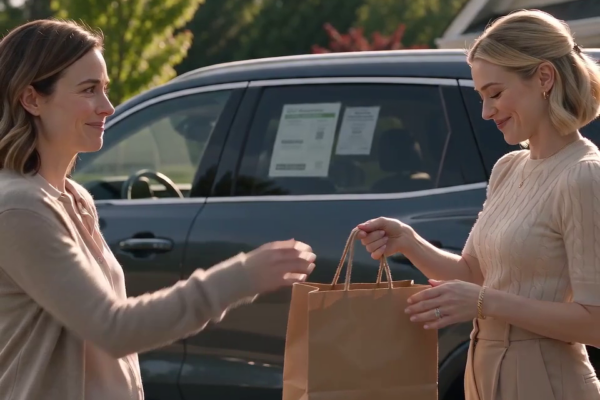
I took the keys from my purse.
Then I stopped.
“Bring it back with gas.”
Carol laughed.
“Deal.”
I handed them to her.
Dad was watching from the kitchen doorway.
He did not say anything.
He did not need to.
The same woman was borrowing the same car.
Nothing about the object had changed.
Only the sentence around it had.
Before, somebody had decided for me.
This time, somebody asked.
And I said yes.