At 39 Weeks Pregnant, My Husband Scheduled a Three-Day Trip With His Parents for My Due Date and Told Me I Could “Go to the Hospital Alone” if Labor Started—Then Called Me Selfish for Wanting Him to Stay Home, Even Though the “Family Tradition” He Refused to Miss Meant Leaving His Wife and First Baby Behind
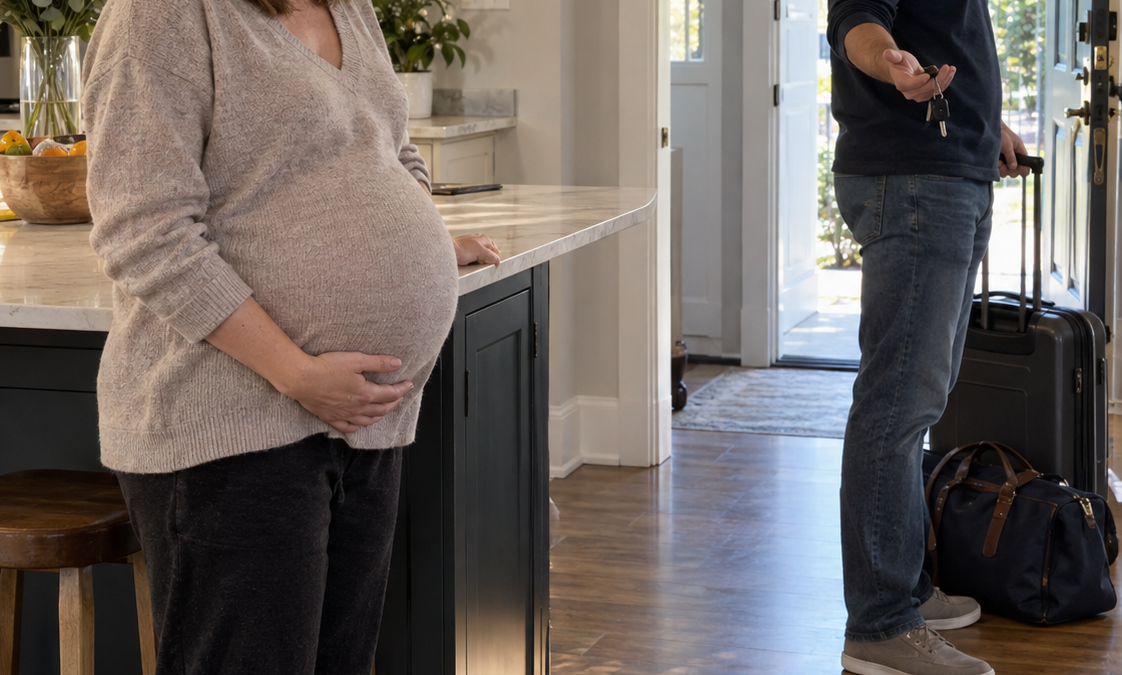
David had been somebody’s son longer than he had been my husband.
I understood that.
What I had not understood when I married him was that he intended to keep those roles in exactly that order.
We had been married three years when I became pregnant.
Our first child.
A girl.
We had already chosen the name Nora.
David was happy about the pregnancy in the way he was happy about most things that did not require immediate sacrifice.
He liked ultrasound photos.
He liked telling coworkers he was becoming a father.
He loved assembling the crib because there were instructions and visible progress.
Pregnancy itself was another matter.
If groceries were heavy, he suggested ordering lighter things.
If I was tired, he reminded me that women had been having babies forever.
If I asked him to skip one of his weekend visits to his parents, he looked at me as though I were trying to isolate him from his family.
His parents lived twenty minutes away.
Still, David spent most Saturdays there.
Sometimes Sunday too.
His mother Patricia cooked for him.
His father Robert always had a project in the garage.
David reverted around them.
Shoes left wherever he stepped out of them.
Coffee cup magically disappearing from the table.
Somebody asking whether he wanted seconds.
I noticed the contrast more sharply once I was pregnant.
At home, David considered making his own lunch an unreasonable disruption.
At his parents’ house, his mother enjoyed doing everything for him.
Then he came home believing that was simply how households worked.
I worked before maternity leave.
I also cooked more often.
Handled laundry.
Kept track of appointments.
Bought almost everything for the baby.
David would tell people:
“We’re ready.”
What he meant was that I had prepared us.
The lake trip arrived every summer.
His parents rented a cabin beside a reservoir.
Three days.
Grilling.
Fishing.
Board games.
It mattered to them.
Normally, I liked it.
But that year the trip began one day before my due date.
I assumed they would cancel.
Nobody did.
At thirty-eight weeks, Patricia asked whether I wanted the downstairs bedroom at the cabin because the stairs might be uncomfortable.
I laughed because I thought she was joking.
She wasn’t.
“I’m not going.”
David looked surprised.
“You already told Mom yes.”
“I told her yes in February.”
“So?”
“So I wasn’t nine months pregnant in February.”
Patricia eventually called to persuade me.
Babies did not operate on schedules.
The hospital near the cabin was perfectly good.
Women traveled while pregnant all the time.
I listened.
Then said no.
That should have solved it.
Instead David announced that he would still go.
The argument happened Thursday night.
He packed while I sat in the kitchen.
“Stay home.”
He looked toward me.
The seriousness of my voice finally made him stop.
“Lisa.”
“I’m scared.”
That was difficult for me to admit.
Pregnancy had been medically normal.
There was no diagnosis to point to.
No emergency.
Just the fact that I had never given birth before and did not know what the next week would bring.
“I need you nearby.”
David rubbed his forehead.
“You want me to cancel because something might happen.”
“Yes.”
“That’s ridiculous.”
“No.”
“It’s my due date.”
“Which means nothing medically exact.”
He had clearly repeated Patricia’s argument.
“Are you seriously explaining due dates to the pregnant person?”
David zipped the suitcase.
“You’ll be fine.”
The phrase landed harder than he intended.
I had been hearing versions of it for months.
You’re fine.
The baby is fine.
Pregnancy isn’t an illness.
Why do you need help?
Why are you tired?
Why can’t you carry that?
Being medically healthy had somehow become evidence that I deserved no consideration.
David lifted his bag.
“If labor starts, go to the hospital.”
I stared at him.
“I’ll meet you there.”
“And if you don’t make it?”
He shrugged.
“Then I don’t make it.”
That answer changed something.
He seemed to realize it too because his face softened.
“Come on. That’s not what I meant.”
But sometimes the first answer is the honest one.
Friday morning, he left.
I spent the day slowly.
Laundry.
A nap.
Toast.
I checked the hospital bag twice.
Around four, Sarah from next door knocked.
She had seen David leave.
Sarah and I were friendly rather than close.
We borrowed things.
Talked over the fence.
Sometimes drank coffee together on her porch.
She had two children in high school.
“Where’d David go?”
“His parents’ lake weekend.”
She looked at my stomach.
“Today?”
“Yep.”
Sarah did not give me the comforting answer I had become used to receiving.
She did not say maybe David needed a break.
She did not say first babies usually arrive late.
She simply said:
“That was a bad choice.”
I looked at her.
Something about having one person name the obvious almost made me cry.
“I’ll be okay.”
“I know.”
Then she pointed across the lawn.
“That doesn’t mean you should have to be alone.”
Before leaving, she made me save her number under ICE.
In case of emergency.
At 10:40 that evening, contractions began.
I tried not to overreact.
I timed them using the app the hospital recommended.
Eight minutes.
Seven.
Six.
Then five.
At 11:17, my water broke.
Every piece of childbirth advice I had heard vanished from my brain.
I called David.
He answered eventually.
Voices behind him.
Someone laughing.
Silverware.
Dinner.
“My water broke.”
He seemed confused.
“Now?”
I nearly said no, next Tuesday.
Instead:
“Yes.”
He asked whether I was sure.
Then asked how far apart the contractions were.
When I told him, I heard Patricia in the background.
I could not make out every word.
Only:
First babies…
Hours…
No reason…
David came back on.
“Go in and get checked.”
“I want you here.”
“We just sat down to dinner.”
For some reason, that sentence became the clearest memory of my marriage.
Not because dinner mattered.
Because he genuinely believed it deserved inclusion in the calculation.
“I’m not asking you to panic.”
My voice was shaking.
“I’m asking you to come home.”
David sighed.
“If they admit you, text me.”
The contraction that followed made the decision for me.
I ended the call.
Sarah answered immediately.
She arrived wearing sweatpants and a sweater buttoned wrong.
She helped me put on shoes.
Took the hospital bag.
Found my insurance card after I forgot where I had put it.
Locked my front door.
Then drove.
She never once told me to calm down.
She told me what was actually happening.
“We’re ten minutes away.”
“You’re doing fine.”
“Breathe with me.”
“We’re turning now.”
Facts.
It turned out facts were more comforting than reassurance.
At the hospital, I was admitted quickly.
Labor progressed faster than anyone had expected.
I sent David one message.
They admitted me. Come now.
He replied:
Leaving after dinner.
Twenty-seven minutes later:
Mom thinks I should wait until contractions are closer.
I stared at the message.
The nurse asked whether I wanted my phone.
“No.”
Sarah switched it off.
Nora arrived at 3:42 Saturday morning.
Seven pounds, one ounce.
A serious little face.
A loud cry.
Dark hair flattened against her head.
The instant she was placed against me, the entire room became smaller.
For months, I had imagined David beside me.
Crying.
Cutting the cord.
Taking the first photograph.
Instead, Sarah stood a few feet away with both hands covering her mouth.
She had tears running down her cheeks.
“I’m sorry,” I whispered.
“For what?”
“You shouldn’t have had to do this.”
She shook her head.
“No.”
Then she looked at Nora.
“But I’m glad you weren’t alone.”
That sentence mattered more than Sarah knew.
David arrived after nine.
So did Patricia and Robert.
By then I had slept for perhaps forty minutes.
Nora was beside me.
My parents had arrived just after sunrise and were downstairs getting coffee.
A nurse came in.
“Your husband is here.”
I stared at the door.
“Alone?”
The nurse hesitated.
“No.”
“Who else?”
“His parents.”
Of course.
I told her David could come in.
Only David.
He entered carrying a backpack and the jacket he had worn on the trip.
He looked exhausted.
Also offended.
That was the part I remember.
He walked toward the bassinet.
“You had her.”
“Yes.”
“You could’ve called.”
“I did.”
“You turned your phone off.”
“After you told me you were finishing dinner.”
David frowned.
“That’s not fair.”
I actually laughed.
My body immediately reminded me not to.
He lowered his voice.
“Mom told me first labor usually takes twelve hours.”
“Your mother was wrong.”
“She was trying to help.”
“No.”
I looked at him.
“She was trying to make the choice easier for you.”
He stared at Nora.
“I missed my daughter being born.”
“Yes.”
“You sound like you wanted me to.”
That stunned me.
“You made the decision.”
“No, Lisa. You could have kept me updated.”
I watched him turn his regret into an assignment I had failed.
It was so familiar.
Then I heard myself say:
“I was busy giving birth.”
David went silent.
The nurse returned and asked whether I wanted Patricia and Robert brought in.
David answered before I could.
“Yes.”
I looked at him.
The nurse noticed.
She asked again.
This time directly to me.
“Lisa?”
“No.”
David’s head snapped toward me.
“What?”
“I’m not ready for visitors.”
“My parents drove all the way back.”
“That was their choice.”
“They want to meet the baby.”
“They can meet her later.”
David lowered his voice.
“You’re punishing them.”
“No.”
For the first time in our marriage, I did not explain further.
I did not make the boundary palatable.
I did not soften it until David could pretend it had been his idea.
“No visitors.”
The nurse nodded.
David left fifteen minutes later.
Not because I threw him out.
Because he said he needed to explain everything to his parents.
That sentence told me where his instincts still lived.
My own parents arrived afterward.
Mom held Nora and cried.
Dad stood beside the window pretending he wasn’t.
I told them what happened.
They did not tell me to forgive David.
They did not tell me all marriages were difficult.
Mom simply asked:
“What do you want to do when you leave here?”
“I don’t know.”
“That’s fine.”
Then:
“You can come home with us.”
I did.
The decision was supposed to be temporary.
Two weeks, maybe.
Enough time to recover.
Enough time to sleep somewhere I did not have to monitor David’s moods while learning how to keep a newborn alive.
The first night at my parents’ house, Mom put Nora’s bassinet beside my bed.
Dad stocked the bathroom with everything he had apparently bought after googling postpartum supplies.
Some of it was completely wrong.
I loved him for buying it anyway.
David called constantly.
At first, he wanted me home.
Then he wanted explanations.
Then he wanted to know when his parents could visit.
Eventually he said:
“You’re acting like I abandoned you.”
I answered calmly.
“You did.”
“I told you to go to the hospital.”
“That is not the defense you think it is.”
He went quiet.
“You knew I would come.”
“I knew you would come when it became convenient enough.”
That conversation ended quickly.
A week later, we met at my parents’ kitchen table.
Nora slept in another room.
David looked worse than I had ever seen him.
He had apparently expected time to turn the situation into a misunderstanding.
It had not.
“I’m sorry I missed the birth.”
“I know.”
“I should’ve come when you called.”
“Yes.”
“I listened to Mom.”
“Yes.”
His jaw tightened.
“You really hate her.”
“No.”
That seemed to surprise him.
“This isn’t about your mother.”
“She told you I’d be fine.”
“You decided to believe her because that answer let you stay.”
David looked away.
That was the first useful silence between us.
Then I told him I wasn’t coming home.
Not yet.
Maybe not ever.
He cried.
I had rarely seen David cry.
Part of me immediately wanted to comfort him.
Old reflex.
I kept my hands around my coffee mug.
“I don’t want to keep being married to someone I have to convince to choose our household.”
“We are your family too.”
“I know.”
“Do you?”
He said nothing.
We separated.
Not dramatically.
No social-media post.
No employer involvement.
No revenge.
David rented an apartment.
We began talking through a counselor because we still had a child together regardless of what happened to the marriage.
At first, he treated counseling like a negotiation.
What exactly did I need before coming home?
How many apologies?
How many weeks?
The counselor eventually stopped him.
“David, she isn’t describing a checklist.”
He frowned.
“What is she describing?”
“A relationship in which she did not feel partnered.”
That sentence landed.
Slowly, David began understanding that the lake weekend was not a single mistake.
It was the cleanest example of three years of decisions.
The beer run.
The dinners.
His mother’s opinions outranking mine.
His expectation that household work simply occurred.
His belief that because pregnancy was normal, I should behave normally regardless of how I felt.
The labor did not create the marriage problem.
It illuminated it.
For his first solo visit with Nora, David arrived at my parents’ house carrying a designer diaper bag.
Inside were diapers in the wrong size and no spare clothes.
Nora needed changing within twelve minutes.
David panicked.
I almost stepped in.
Mom touched my arm.
“Let him learn.”
So I did.
He learned.
Slowly.
He learned how to hold a bottle while checking the temperature.
How to recognize the cry that meant hungry versus overtired.
How to install the stroller without swearing loudly enough to alarm neighbors.
He learned that two hours alone with an infant could feel longer than an entire workday.
He stopped calling his mother every time he was unsure.
Not because Patricia disappeared.
Because eventually David understood that being a father required developing judgment of his own.
Three months passed.
Then six.
I decided to file for divorce.
David asked whether the marriage really had to end when he was finally changing.
That was the hardest question.
Because he was changing.
I could see it.
But somebody becoming better does not automatically restore what was lost.
“I’m glad you’re becoming the father Nora deserves.”
He looked down.
“What about the husband you deserve?”
“I don’t know if I can trust him again.”
David nodded.
For once, he did not argue.
The divorce was quieter than our marriage had been.
We established a parenting schedule.
David paid his share.
There were no dramatic battles.
Patricia complained initially.
Eventually she learned that Nora’s schedule did not revolve around family tradition.
I learned something too.
Leaving David did not require turning him into a monster.
He had been selfish.
Entitled.
Deeply immature.
He had also loved our daughter enough to confront things about himself he had spent years avoiding.
Both facts could exist.
Nora turned one on a Saturday.
My parents offered their backyard.
Sarah came.
Of course she did.
She brought a picture book instead of another noisy toy.
Patricia and Robert attended.
So did David.
He arrived forty minutes early.
I was taping a paper banner to the fence.
Old me would have immediately handed him six jobs while simultaneously doing all of them myself.
Instead I pointed toward the cooler.
“Ice needs to go in there.”
“Got it.”
He did it.
Then asked:
“What next?”
“Nothing right now.”
David looked surprised.
“You can sit down.”
He laughed.
“That feels like a trap.”
“It isn’t.”
Guests arrived.
Nora smashed frosting into her hair.
Sarah took too many photographs.
Dad grilled burgers badly.
Patricia tried not to reorganize the gift table.
It was imperfect.
It was also peaceful.
At one point, David stood beside me watching Nora crawl across the blanket.
“I think about that weekend all the time.”
I knew which weekend.
“I wish I could redo it.”
“You can’t.”
“I know.”
Then he said something different from all his old apologies.
“I’m sorry you had to learn I wasn’t dependable while you were in labor.”
That was finally the right apology.
Not:
I’m sorry I missed it.
Not:
I’m sorry you were hurt.
He understood what I had lost.
Trust.
“I appreciate that.”
We stood quietly.
There was no reunion.
No kiss.
No suggestion that one honest sentence could undo everything.
David was Nora’s father.
He was becoming a good one.
He was no longer my husband.
Both could be true.
Later, Sarah helped me collect paper plates.
“You okay?”
“Yeah.”
She smiled.
“You mean actually okay?”
I looked across the yard.
David was wiping cake from Nora’s hands.
My parents were arguing over leftover hamburgers.
Patricia was showing Robert approximately forty-seven nearly identical baby photos.
Nobody needed me to manage the moment.
I was simply standing inside it.
“Actually okay.”
Sarah bumped her shoulder gently against mine.
One year earlier, she had driven me to the hospital because the person who promised to be my partner had chosen dinner at a lake cabin instead.
I once thought that night was the story of my family falling apart.
It wasn’t.
It was the moment I stopped insisting that a family had to stay in one shape to remain a family.
Nora still had a father.
She had grandparents.
She had Sarah, who she called Aunt Sarah before she could pronounce half the alphabet.
And she had me.
A mother who no longer mistook endurance for marriage.
When the party ended, David packed Nora’s gifts into his car because it was his weekend.
Before closing the trunk, he looked toward me.
“I’ll bring her back Sunday at six.”
“Okay.”
“And I already packed her medicine.”
I smiled.
“Look at you.”
“Growth.”
“Don’t get cocky.”
He laughed.
Then drove away with our daughter.
I watched until the car turned the corner.
Not because I was worried.
Because I wasn’t.
That might have been the biggest change of all.
The man who once told me I could go to the hospital alone had finally learned how to show up.
Just too late to remain my husband.
And I had learned that someone becoming better did not require me to return to the place where I had learned to expect less.