After Saving Airline Miles for Three Years to Fly First Class to My Daughter’s Graduation, I Took My Assigned Seat in a Plain Hoodie—Then the Lead Flight Attendant Ordered Me Out in Front of a Full Cabin and Said, “Our Premium Passengers Usually Present Themselves Differently,” Even Though My Boarding Pass Clearly Said 2A
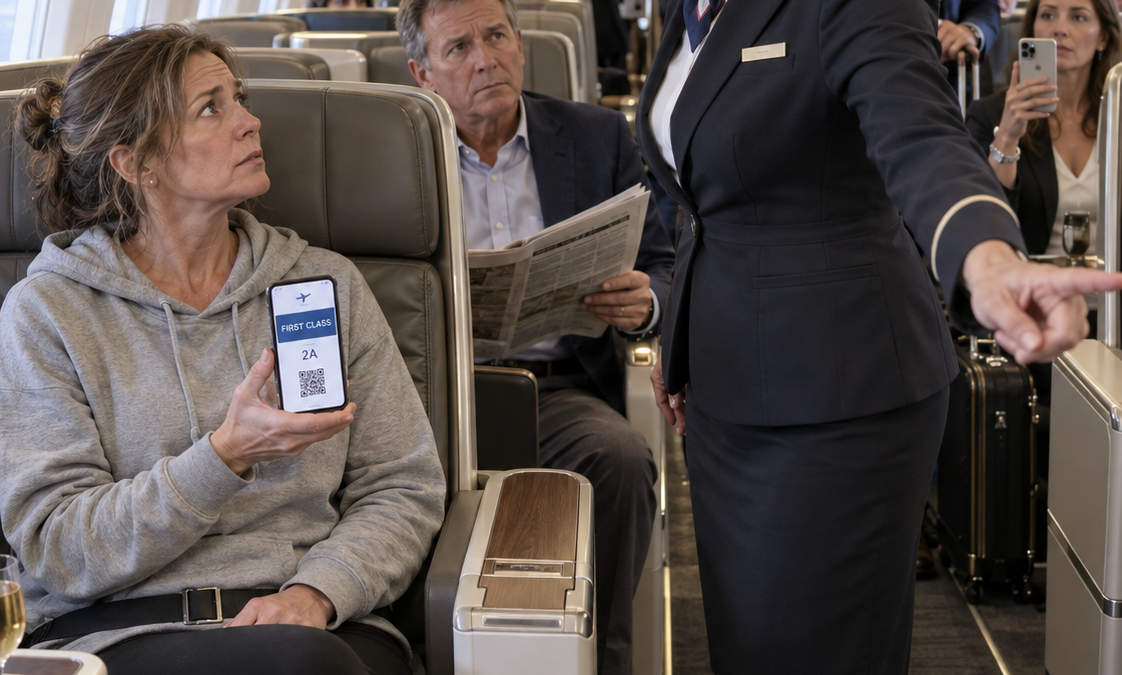
Seat 2A was already buckled around me when the lead flight attendant stopped beside my row.
“Ma’am, I need to see your boarding pass.”
I looked up.
She had silver-blonde hair pinned neatly at the back of her head and the polished expression of someone who had spent years learning how to smile without necessarily being friendly.
Her name badge said BRENDA.
I unlocked my phone.
The airline app was still open.
“Here.”
She took one quick look.
Then another at me.
That second look lasted longer.
Gray hoodie.
Black leggings.
White sneakers.
Canvas tote under the seat.
My hair twisted into a loose knot because I had come directly from work, changed in an airport restroom and wanted nothing more complicated from the next five hours than sleep.
“Two-A?” she asked.
“Yes.”
I pointed to the screen.
“Two-A.”
She nodded slowly.
Then said:
“I’m going to need you to step out of the premium cabin while we straighten this out.”
For a second I thought I had misunderstood.
“Straighten what out?”
“Your seating.”
“My seat is 2A.”
“I understand what your phone says.”
What your phone says.
Not:
Yes, I see that.
Not:
Let me verify.
The phrasing made the problem sound like my boarding pass was an opinion.
“What does your manifest say?”
Brenda’s smile tightened.
“Please gather your things.”
The first-class cabin was almost full.
Twelve seats.
Pairs on each side of the aisle.
Most passengers had been settling into the quiet rituals people perform before takeoff.
Laptop away.
Jacket folded.
Water bottle opened.
Phone connected.
Now those movements were slowing.
The man in 2B had lowered his newspaper.
Across the aisle, a woman with dark-framed glasses took one earbud out.
Two rows behind us, somebody stopped talking.
Public embarrassment is strange.
You can feel attention without seeing it.
My face became hot.
I hated that.
Not because I believed embarrassment proved guilt.
Because my body had always reacted before my brain did.
“I’m happy to show you identification,” I said.
“That won’t be necessary.”
“Then what is necessary?”
“For you to step outside.”
“Why?”
“There’s a seating matter the gate staff needs to resolve.”
“With me?”
She didn’t answer directly.
I opened my boarding pass larger.
Atlanta to Seattle.
Flight 417.
First class.
Seat 2A.
Caroline Hayes.
I had purchased the ticket four months earlier.
Well, mostly purchased.
For three years, I had been saving airline miles.
Not strategically.
I wasn’t one of those people with spreadsheets calculating which credit card earned three points per dollar at grocery stores and five at gas stations.
I simply traveled several times a year for work, used one airline whenever the schedule made sense and watched the balance grow.
Usually I spent miles on ordinary economy tickets.
This time I didn’t.
My daughter Sophie was graduating from architecture school in Seattle.
She was twenty-six.
It had taken her six years to finish.
Not because she was lazy.
Because life was expensive.
She worked.
Changed schools once.
Took one semester off when tuition increased.
There had been moments when she considered quitting entirely.
She didn’t.
When the graduation date arrived, I wanted to be there rested.
That sounds like a small thing until you have spent twenty years taking the cheapest flight available, sitting beside the restroom, eating pretzels and telling yourself that comfort is something you buy only when practicality has already been satisfied.
I was fifty-two.
I had raised Sophie mostly alone after my husband died when she was eleven.
I worked as payroll manager for a manufacturing company outside Atlanta.
Solid job.
Decent salary.
Good benefits.
Nothing glamorous.
I had saved enough miles for an upgrade and then used some cash to complete the first-class fare.
It felt extravagant.
I almost talked myself out of it.
Sophie didn’t.
When I told her, she said:
“Mom. Please have one nice thing without writing a defense brief.”
So I booked it.
Seat 2A.
Four months in advance.
The day of the flight, quarter-end payroll ran late.
I left the office at 5:20.
My flight boarded at 7:05.
I changed into comfortable clothes in the airport because I wanted to sleep.
That was apparently the mistake.
The man in 2B spoke.
“She boarded before me.”
Brenda turned toward him.
He was maybe sixty.
Gray suit.
Reading glasses.
Wedding ring.
Nothing about him suggested he wanted to be involved.
But he continued.
“I watched the gate agent scan her pass.”
Brenda gave him the same professional smile.
“Thank you, sir. We’re handling it.”
He leaned back.
The woman across the aisle had now removed both earbuds.
Brenda looked at me again.
“Ma’am.”
“My name is Caroline.”
“Ms. Hayes, please come with me.”
That was when a man appeared behind her.
He had just entered the cabin.
Late forties.
Expensive navy blazer.
Leather carry-on.
He glanced at the overhead bins, then at the seat numbers.
His gaze stopped on 2A.
Brenda looked at him.
Then at me.
The movement was tiny.
Enough.
“Is he supposed to have this seat?” I asked.
Brenda’s expression hardened.
“There are adjustments we sometimes make for premium travelers.”
“I am a premium traveler.”
She inhaled.
I waited.
Then she said:
“Our premium passengers usually present themselves differently.”
Silence.
Complete silence.
The man beside me turned his head.
The woman across the aisle stared openly now.
I looked at Brenda.
“Differently how?”
For the first time, she seemed uncertain.
“I mean our frequent premium travelers are generally familiar with the cabin.”
“That’s not what you said.”
“Ms. Hayes—”
“What part of how I present myself changes the seat on my boarding pass?”
“That is not what I meant.”
“It sounded very specific.”
She glanced around.
Now she understood the whole cabin had heard her.
That made her firmer instead of softer.
“I’m instructing you to leave the aircraft temporarily.”
“Why?”
“So the gate team can correct the seat assignment.”
“Is my seat assignment incorrect?”
“You need to step outside.”
The man who had boarded late finally spoke.
“Excuse me.”
Brenda turned.
He looked uncomfortable.
“I asked at the gate whether there was anything available farther forward. They told me the cabin was full.”
Brenda said:
“Mr. Mercer, we’re trying to accommodate you.”
His eyebrows went up.
“I didn’t ask you to remove somebody.”
“There appears to be a system issue.”
He looked at my phone.
Then at her.
“What system issue?”
She didn’t answer.
Everything became clearer.
Mr. Mercer had a valid first-class ticket.
Just not seat 2A.
He wanted farther forward.
Maybe near a colleague.
Maybe because he preferred the window.
It did not matter.
The important thing was that someone had decided his preference was easier to satisfy by moving me.
Why me?
I already knew.
Brenda had told me.
Premium passengers usually present themselves differently.
I unfastened my seat belt.
Her shoulders relaxed.
“Thank you.”
I did not stand.
“If the airline is involuntarily downgrading me, please bring the gate supervisor here.”
She blinked.
“What?”
“I want the downgrade documented.”
“There’s no need to make this complicated.”
“I didn’t.”
The man beside me covered a smile with his hand.
I continued.
“I also want to know the compensation and whether my checked bag needs to be retagged if you move me to another cabin.”
“I haven’t said where you’re going.”
“Then where am I going?”
Her face tightened.
A younger flight attendant had been standing near the forward galley throughout most of the exchange.
She looked no older than thirty.
Dark hair in a bun.
Name badge:
JASMINE.
Until then, she had said nothing.
Now she stepped forward.
“Brenda.”
Brenda turned.
Jasmine’s eyes flicked toward me.
Then the passenger screen near the galley.
“Her seat is valid.”
The entire cabin seemed to inhale.
Brenda’s face changed.
“Jasmine.”
“I checked the manifest before we started boarding.”
“You’re not involved in this.”
“Two-A is Ms. Hayes.”
Brenda spoke through her teeth.
“We can discuss this later.”
I said:
“Thank you, Jasmine.”
She nodded once.
Brenda turned toward me.
Her expression now had no softness left.
“This is an operational matter.”
“Apparently.”
Footsteps came from the aircraft door.
A gate agent walked into the cabin carrying a tablet.
“What’s going on?”
Brenda immediately said:
“We have a seat conflict.”
Jasmine said:
“We don’t.”
The gate agent stopped.
His name tag said DEVON.
He looked at Brenda.
Then Jasmine.
Then me.
“Can I see your pass, ma’am?”
I handed him my phone.
He checked the tablet.
“Caroline Hayes.”
“Yes.”
“Seat 2A.”
“Yes.”
He looked toward the late passenger.
“Mr. Mercer?”
“Four-D.”
Devon nodded.
“Then there’s no conflict.”
Brenda said:
“He asked about moving forward.”
Devon frowned.
“And?”
“I was trying to accommodate him.”
Mr. Mercer shook his head.
“I asked if a seat was open.”
Devon looked at Brenda.
“Nothing is.”
She said:
“I was told we might be able to make an adjustment.”
“By who?”
No answer.
The woman across the aisle lifted her phone.
“I recorded most of this.”
Everyone looked at her.
She shrugged.
“She told that woman first-class passengers usually present themselves differently.”
Brenda’s face went red.
“That is not the context.”
“What context makes that better?” the passenger beside me asked.
Nobody answered.
Devon stepped toward the galley.
“Brenda, can I speak with you at the door?”
She didn’t move at first.
Then she did.
As she passed my seat, she didn’t look at me.
Mr. Mercer waited in the aisle.
I said:
“I’m sorry you got pulled into this.”
He actually looked embarrassed.
“You have nothing to apologize for.”
Devon returned.
“Mr. Mercer, your confirmed seat is 4D.”
“That’s fine.”
He walked back.
Devon looked at me.
“Ms. Hayes, you are staying in 2A.”
“I know.”
His expression tightened slightly.
Fair.
It was not his mistake.
“I apologize.”
“Thank you.”
Then I asked:
“Can I get the name or email address for filing a formal incident report?”
Brenda was still at the door.
I saw her look back.
Devon nodded.
“Yes.”
He wrote something on the back of a boarding envelope.
“Customer care reference. Include the flight number. I’ll also note the issue in the departure record.”
That mattered more than a dramatic apology.
A record.
I took it.
Jasmine brought me water.
“I’m sorry,” she said.
“You didn’t do it.”
“I should have stepped in sooner.”
I looked at her.
She was probably right.
But I also understood why she hadn’t.
Brenda had seniority.
Authority has gravity.
People wait to see whether someone else will resist it first.
“Thank you for saying something.”
Jasmine nodded.
The woman across the aisle leaned over.
“I’m Denise.”
“Caroline.”
“AirDrop?”
I laughed despite myself.
“I have Android.”
“Of course.”
For some reason, that broke the tension.
The man in 2B laughed too.
Denise said:
“Text?”
I gave her my number.
A minute later, the video arrived.
Three minutes long.
I watched the first twenty seconds without sound.
Me in my gray hoodie.
Brenda standing over me.
The cabin watching.
I stopped.
I did not want to spend the flight replaying it.
The door closed.
Pushback began twelve minutes late.
Brenda remained on the flight.
That surprised me.
I had imagined Devon might remove her.
Real life is usually less cinematic.
She performed the safety demonstration professionally.
Jasmine handled most of our cabin service.
Brenda came through once with the beverage cart.
When she reached me, she asked:
“Would you like anything to drink?”
Her tone was perfectly neutral.
“Tea, please.”
She poured it.
No apology.
No comment.
That was fine.
I did not need closure at thirty thousand feet.
I needed the airline to know what happened.
I slept for almost two hours.
The seat was comfortable.
That felt strangely important.
I had paid for comfort.
I stayed long enough to receive it.
We landed in Seattle after ten.
Sophie was waiting at baggage claim.
She ran toward me.
Then stopped.
“You look weird.”
“Hello to you too.”
She hugged me.
“I mean emotionally weird.”
“You’ve known me twenty-six years and still think that is useful information?”
She laughed.
In the car, I told her.
Not dramatically.
Boarding.
Seat.
Brenda.
The comment.
Video.
Sophie’s hands tightened on the steering wheel.
“She said what?”
I repeated it.
“Oh, absolutely not.”
“Sophie.”
“No.”
“What are you doing?”
“Nothing while driving.”
“Good.”
“At home I’m helping you file everything.”
I smiled.
“You sound like me.”
“That is deeply upsetting.”
We laughed.
At her apartment, she watched the video.
Once.
She didn’t say anything for several seconds.
Then:
“Mom, you looked embarrassed.”
That was the sentence that got me.
Not angry.
Not powerful.
Embarrassed.
“Yes.”
“You shouldn’t have been.”
“I know.”
“No, I mean—”
She paused.
Then said:
“You shouldn’t have to dress like a receipt to prove you paid.”
I looked at her.
“That is a very architecture-student sentence.”
“I’m graduating tomorrow. Respect me.”
We filed the complaint.
I attached the boarding pass.
Denise’s video.
Devon’s reference.
I wrote the exact words I remembered.
I did not write:
Fire her.
I did not demand money.
I wrote:
I want the airline to explain why a valid first-class passenger was selected for removal after a late passenger asked for a different seat, and why my clothing or appearance was treated as relevant to whether I belonged in the cabin.
Then I submitted it.
The next day was Sophie’s graduation.
That was why I had come.
And I refused to let Brenda become the main character of it.
Sophie wore a black gown over a white dress.
Her cap kept sliding backward because she had pinned it badly.
When her name was called, I stood.
Cheered too loudly.
Cried.
Did not care.
Afterward we ate tacos from a truck outside campus because every restaurant nearby had a two-hour wait.
That evening, an email from the airline arrived.
They had opened an investigation.
Fine.
I closed it.
Three days later, a customer-care manager called.
Her name was Anita.
She had reviewed the video and spoken to the gate team.
“What happened should not have happened,” she said.
“Okay.”
“I also want to be transparent that we’re still interviewing crew.”
“I appreciate that.”
Then she told me something I hadn’t known.
Jasmine had filed an internal report before takeoff.
Not after landing.
Before.
That mattered.
Her report stated that Brenda had asked crew members, before I boarded, whether there was “someone easy to move” if a top-tier passenger wanted to shift forward.
No seat conflict existed.
No duplicate reservation.
No system error.
There had been a preference.
Then a choice.
Me.
“Did she identify me before seeing me?” I asked.
“No.”
“So she chose after I boarded.”
Anita paused.
“The review suggests appearance influenced how she approached the situation.”
There it was.
Plain.
No dramatic conspiracy.
No secret executive.
Just someone making a biased convenience decision.
“What happens now?”
“I can’t discuss employee discipline.”
Fair.
She continued.
“We are refunding the cash portion of your fare and restoring the miles used for the upgrade.”
“I didn’t ask for that.”
“I know.”
I accepted.
Not as a prize.
As acknowledgment.
Then I asked:
“What about training?”
She described changes being reinforced with the premium-cabin team.
Boarding-pass verification.
Involuntary seat changes.
Customer treatment.
I could not know whether one incident transformed anything.
Probably not.
But something had entered a system that previously would have vanished as soon as the cabin door closed.
A record.
Weeks later, Denise—the passenger who recorded the video—texted me.
Any update?
I told her the broad version.
She replied:
Good. Also never change the hoodie.
I still have it.
Of course I do.
Six months later, I flew first class again.
Not because I was proving something.
My company sent me to Phoenix and purchased the ticket.
I wore the same gray hoodie.
Different sneakers.
Seat 3A.
The flight attendant scanned my boarding pass at the cabin entrance.
“Welcome aboard, Ms. Hayes.”
That was all.
No second look.
No evaluation.
No test.
I sat down.
Across the aisle, a man in a tailored suit took off his shoes almost immediately and put on bright red travel socks.
I nearly laughed.
Premium presentation, apparently.
I opened my book.
Nobody cared what I looked like.
Exactly as it should have been.
The strange part was that the original incident stopped feeling like a story about first class.
It became something simpler.
A stranger had looked at me and decided I was the easiest person to displace.
For most of my life, I probably would have helped her do it.
I would have moved.
Complained later.
Told myself I didn’t want a scene.
But that night, I stayed in 2A.
Not because it was luxurious.
Because it was mine.