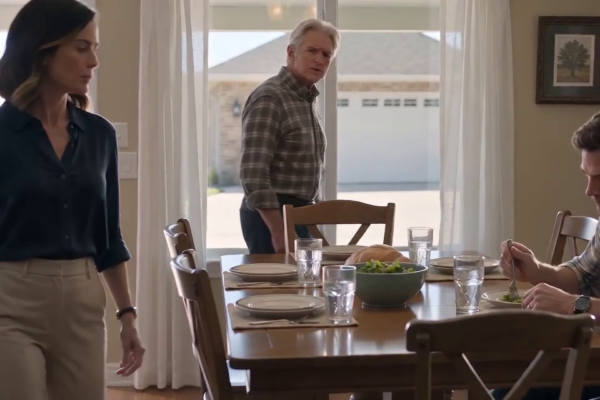
My dad promised he’d sit in the front row for my valedictorian speech and celebrate afterward—but when my name was called, his seat was empty because he was posing with my sister at her spa anniversary party
Dad promised he would be there.
Front row.
He said we would go to dinner after graduation.
He even told me to keep my valedictorian speech from running too long because he had a surprise planned.
I should have known better than to build that much hope around one promise.
But I did.
Three weeks before graduation, my bedroom floor was covered with college letters.
Cornell had rejected me.
Northwestern too.
Duke had given me a wait-list decision.
I tried pretending none of it mattered.
I told myself those schools were not places I truly wanted anyway.
That was easier than admitting rejection hurt.
Still, I had one thing nobody could take away from me.
I was graduating as valedictorian of Roosevelt High.
That title had not appeared because I was naturally brilliant.
It came from years of working when nobody was watching.
Friday nights at my desk.
Essays rewritten while the rest of the house slept.
Assignments submitted from a laptop that sometimes barely survived the chaos around me.
My older sister Tiffany lived differently.
She liked attention.
And attention liked her.
She had always known how to make a room reorganize itself around her.
Even when I was younger, she would throw “small” backyard parties that somehow involved string lights, dozens of people and hired help.
She could turn anything into an event.
I usually stayed in my room studying.
Once, while I was trying to submit a college essay, Tiffany overloaded the power circuit using lighting equipment for a live-streamed spa demonstration.
My computer shut off.
I restarted it.
Recovered the document.
Kept working.
That was how I handled most things.
Quietly.
Tiffany made noise.
I adjusted.
Dad admired her ability to attract people.
When I was younger, I used to wonder whether he admired anything about me with the same energy.
He insisted there was no favoritism.
“Tiffany is just naturally good with people.”
Apparently being loud enough to be noticed was a talent.
Being dependable enough not to demand attention became invisible.
It hadn’t always felt that way.
When Tiffany and I were children, Dad made us peanut-butter-and-banana sandwiches and called us “his girls.”
Somewhere around middle school, the team changed.
Tiffany became the star.
I became the reliable daughter who showed up early, worked hard and rarely needed help.
By graduation week, I had learned not to expect big emotional gestures from him.
That was why his promise mattered.
He passed me in the hallway one evening and said:
“You know I’ll be there, right?”
I looked up.
“Front row.”
Then he added, “Don’t get too emotional up there.”
That was as close as Dad usually came to saying he was proud of me.
I held onto it.
He would be there.
I even declined an invitation from one of my favorite teachers to get milkshakes with the honors students after the ceremony.
Dad had said we would celebrate.
I wanted to believe something had been planned specifically for me.
Graduation morning was hot.
Mom stood near the bleachers beside me before the ceremony.
Tiffany wasn’t coming.
She had a business event downtown connected to her spa.
She texted:
Break a leg, little sis. You’re going to kill it.
I didn’t answer.
I was focused on one thing.
The front row.
The ceremony began.
Students crossed the stage one after another.
Eventually, the principal announced:
“Valedictorian of the Roosevelt High graduating class, Anna Reynolds.”
I stood.
Applause filled the gym.
I looked toward my family.
Mom was there.
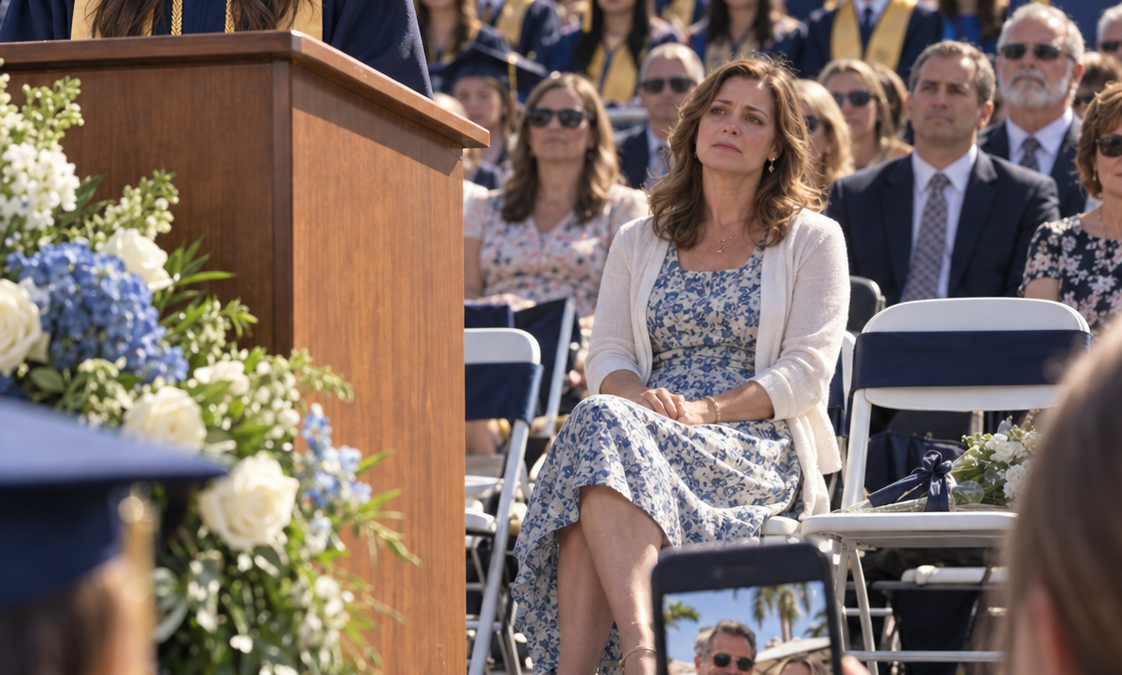
Beside her was the reserved seat with Dad’s name.
Empty.
My chest went cold.
Still, I walked to the microphone.
I smiled.
I breathed.
Then, just before I began, something caught my attention.
Behind one of the main cameras was a monitor showing the ceremony stream.
Nearby, someone had Tiffany’s social-media story open.
The clip began playing.
And Dad appeared.
He was wearing a white linen shirt.
Sunglasses hung from his collar.
A champagne flute was in his hand.
Tiffany stood in front of him at her spa anniversary event.
Dad looked proud.
Not distracted.
Not apologetic.
Happy.
The post had been uploaded while my graduation ceremony was happening.
I looked toward his empty chair.
Then back toward the camera recording my speech.
Dad had promised a surprise.
He had delivered one.
Just not the kind either of us expected.
I stepped closer to the microphone.
The speech I had practiced disappeared from my mind.
I started with gratitude.
Teachers.
Mentors.
The community.
Then I talked about what it had taken to reach that stage.
Early mornings.
Late nights.
Missed events.
Deadlines.
The quiet sacrifices people rarely photograph.
Then my words shifted.
“I learned that support isn’t loud.”
The room settled.
“It doesn’t need an Instagram post or a hashtag to be real.”
I looked into the camera.
“Support is presence.”
A few faces in the audience changed.
“Loyalty doesn’t need a name tag or a champagne glass.”
Another pause.
“Loyalty just shows up.”
I never mentioned Dad.
I never said Tiffany.
That was intentional.
The people who knew would understand.
The people who didn’t could hear it as a general lesson.
I finished with something safe about hope, change and resilience.
Applause followed.
I walked off the stage.
As I descended the steps, I heard two students whispering.
“Did you see Tiffany’s story?”
I checked my phone.
Another clip had been posted.
Tiffany and Dad clinking glasses.
Timestamped during my speech.
The caption:
“Family first.”
Something inside me finally stopped asking questions.
Dad had made a choice.
He simply hadn’t had the courage to tell me before I walked onto the stage.
Over the next few days, parts of my speech traveled through our local community.
Not viral in some enormous internet sense.
But people shared it.
Teachers reposted lines.
Students talked about it.
Three days later, Tiffany sent me an invitation.
The family wanted to host a graduation dinner for me.
A new high-end seafood restaurant downtown.
Mom called after I didn’t respond.
“Just come, Anna.”
I agreed.
I wore a simple black dress.
When I arrived, my parents were already there.
Dad stood dramatically.
“There she is. The star of the show.”
I sat across from him.
I said nothing.
A few of Tiffany’s friends were there too.
Then Tiffany entered twenty minutes late.
She wore white.
Of course she did.
She sat beside Dad.
Once drinks were poured, she tapped her glass with a fork.
Everyone looked toward her.
“I just want to say how proud I am of my little genius sister.”
My shoulders tightened.
“She’s always been the quiet one. But wow, what a speech.”
A few people laughed.
Then Tiffany turned toward Dad.
“And this family wouldn’t be what it is without the man who made us strong.”
She raised her glass.
“Dad, you’re the rock. The king. The legend.”
People applauded.
Dad smiled.
I drank water.
Then a waiter appeared with a large white cake.
Gold lettering covered the top.
It did not say congratulations to Anna.
It celebrated Tiffany’s spa anniversary.
One of Tiffany’s friends actually looked confused.
“I thought this dinner was for Anna’s graduation.”
Tiffany did not hesitate.
“It’s both. It’s all about family wins.”
Both.
That word told me everything.
Even the make-up celebration Dad missed graduation for could not remain mine.
I looked across the table at him.
He smiled as though nothing was wrong.
So I reached into my purse.
The night before, I had edited a short video.
Nothing fabricated.
Nothing exaggerated.
Just timing.
My graduation speech.
Tiffany’s own social-media posts.
When my recorded voice said:
“Loyalty is showing up, not showing off,”
the screen showed Dad clinking champagne glasses with Tiffany while I stood behind the graduation microphone.
I propped my phone upright.
Pressed play.
For the first few seconds, people ignored it.
Then they heard my voice.
They saw Dad.
The table slowly became silent.
Tiffany’s smile changed first.
Dad reached for his wine.
Mom looked away.
I didn’t make a speech.
The video did not need one.
After dinner, Mom drove me home.
I sat in the back seat watching streetlights move across the windows.
The video remained open on my phone.
I posted it to my personal account.
The caption was simple:
Some dads only show up for the photos.
By morning, messages had arrived from people I barely knew.
Former classmates.
Teachers.
People from church.
Some said they had lived through something similar.
Others simply said the speech had meant something to them.
Dad called before noon.
I let it ring twice.
On the third call, I answered.
“What the hell were you thinking?”
His anger came immediately.
“Do you know what this makes me look like?”
I waited.
“This is betrayal. You humiliated me.”
That word almost made me laugh.
He was worried about being publicly absent.
I had been privately living with his absence for years.
“I told the truth.”
Then I ended the call.
Tiffany texted next.
She called me jealous.
Said I was spiraling.
Said people would remember what I had done.
She was right about one thing.
People would remember.
I simply no longer believed that was a threat.
Mom responded differently.
She came into my room later carrying tea.
She placed it on my desk.
Then sat on the edge of my bed.
She didn’t defend Dad.
She didn’t defend Tiffany.
She barely spoke.
For once, her silence felt less like avoidance and more like recognition.
I thought that might be the end.
Then an email arrived.
Roosevelt Community Leadership Forum.
Keynote invitation.
They wanted me to speak.
Not about grades.
Not specifically about graduation.
About leadership.
Voice.
Showing up without applause.
Learning to speak after being ignored.
The local chamber of commerce would host the event.
Teachers.
Students.
Community members.
And Dad.
He sat on the board.
For a long time, I stared at the invitation.
Old Anna would have declined.
She would have decided the attention was embarrassing.
She would have disappeared before anyone could accuse her of seeking the spotlight.
I clicked accept.
On the day of the forum, I arrived early.
The auditorium smelled new.
I wore a plain navy dress.
No dramatic entrance.
No elaborate styling.
Dad sat in the third row.
This time he was there.
Tiffany arrived late and sat toward the back.
I stepped onto the stage.
I didn’t use notes.
I began talking about masks.
Not literal ones.
The roles families hand us when we are young.
The loud child.
The successful child.
The difficult child.
The quiet child.
The role you repeat so long that eventually you forget it was assigned to you.
I talked about affection given only when cameras were nearby.
About disappointment disguised as discipline.
About learning to become small because being easy seemed safer than being seen.
I never named Dad.
I never named Tiffany.
I didn’t need to.
Every sentence belonged to me whether they recognized themselves or not.
Dad barely moved.
Tiffany, for once, did not touch her phone.
I ended simply.
“Sometimes taking the mask off isn’t about finally being seen by them.”
The room was completely still.
“It’s about seeing yourself again without their filter.”
I paused.
“And deciding you don’t need their permission to exist clearly.”
The applause began slowly.
Then grew.
Backstage afterward, Tiffany approached me.
“You could have just told me.”
I looked at her.
“You wouldn’t have listened.”
She stared.
“And he never will.”
Tiffany walked away.
Dad did not approach me at the event.
That night he called.
I watched his name appear on the screen.
I did not answer.
Instead, I opened a photograph from graduation.
Mom sitting in the crowd.
The empty reserved chair beside her.
I posted it.
One sentence:
Sometimes silence is louder than applause.
A message arrived from a number I didn’t know.
I saw your speech. I think my daughter needs to hear it. Thank you.
I read the words several times.
Then I put the phone down.
Maybe some people would call me bitter.
Others might call me brave.
I no longer needed either label.
The truth was simpler.
For years I had waited for Dad to look at me the way he looked at Tiffany.
I had believed that if I worked hard enough, achieved enough or stayed easy enough to love, eventually he would show up.
Graduation taught me something harder.
I could not control who occupied the chair beside Mom.
I could control whether the empty seat became proof that I mattered less.
It didn’t.
Dad missed the speech.
The speech still happened.
He missed the moment.
The moment still belonged to me.
And when I finally stopped measuring myself by who showed up to applaud, I discovered something that had been true long before graduation.
I had never needed his front-row seat to know how far I had come.