My parents emptied the college fund they had promised me since childhood to bail out my older brother and cover the mess from his gambling debts—then looked at me holding my dream-school acceptance letter and said, “He needed it more”
College was never just one goal among many for me.
It was the goal.
For as long as I could remember, I had pictured myself leaving our small town, walking across a college campus somewhere far away and building a life around words.
I wanted to study journalism.
I wanted classrooms full of people who cared about stories and ideas. I imagined writing for a student newspaper, chasing assignments across campus and eventually turning that obsession into a career.
My parents knew all of it.
They encouraged it.
Mom used to tell people I would be the first person in our immediate family to earn a four-year degree.
Dad would pat me on the shoulder whenever I worried about tuition.
“We’ve been saving for this since you were born,” he’d say. “You do your part. We’ll do ours.”
So I did my part.
I studied late.
I worked at a local restaurant during high school.
I applied for scholarships.
I skipped things my friends did because I had papers to finish or shifts to cover.
None of it bothered me much because I believed I knew where I was going.
Then the acceptance letter arrived.
The school was across the country.
Small.
Prestigious.
Exactly the kind of place I had imagined.
Tuition was expensive, but I had already earned several scholarships, and between those, my part-time savings and the college fund my parents had spent years talking about, I believed the remaining cost was manageable.
I walked home that afternoon holding the envelope as though I were carrying proof that every late night had mattered.
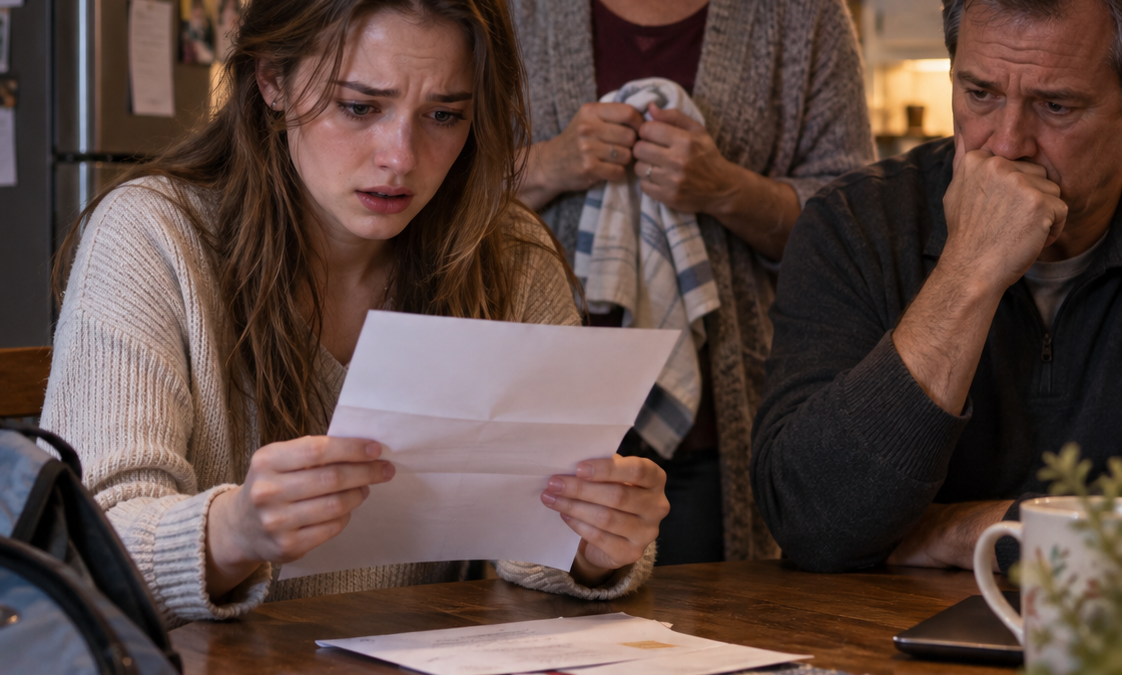
That evening, Mom called me into the kitchen.
The first thing I noticed was her face.
She was pale.
She kept rubbing a dish towel between her hands.
Dad sat at the table with his shoulders slumped, staring at the grain in the wood.
The acceptance letter was still in my hand.
“What happened?”
Mom glanced toward Dad.
He sighed.
“It’s your brother.”
Jason.
Five years older than me.
We had never been particularly close.
Jason was charming when he wanted to be and unpredictable almost all the time. He drifted through jobs, friendships and plans as though consequences were things that happened to other people.
“What about him?”
Mom hesitated.
“He got arrested.”
I stared at her.
There were gambling debts involved, she explained, along with people and problems my parents believed could become much worse if they weren’t handled immediately.
I still didn’t understand why I had been called into the kitchen.
“What does that have to do with me?”
Dad finally met my eyes.
“We used the college fund.”
For several seconds, I said nothing.
“What?”
Mom started speaking quickly.
There were debts.
There was bail.
They were frightened.
Jason was in serious trouble.
“He needed us,” she said.
I looked at Dad.
“My college money?”
He nodded.
“The money you’ve been saving my whole life?”
Another nod.
Then came the sentence that changed the way I saw all three of them.
“He needed it more.”
I looked down at my acceptance letter.
Only a few hours earlier, it had been the happiest piece of paper I had ever held.
Now it felt almost cruel.
They hadn’t asked.
They hadn’t discussed it with me.
They hadn’t even warned me that the account was in danger.
They had simply decided that Jason’s emergency outranked my future.
“How could you do that?”
My voice shook.
Mom leaned toward me.
“Jason is your brother. Family helps family.”
I almost laughed.
If family helped family, where had I been in that calculation?
What they had taken wasn’t only money.
It was choice.
Independence.
A promise.
Years of planning.
And sitting at that kitchen table, I understood something I wasn’t ready to say aloud.
My parents had been forced to choose between protecting Jason from the consequences of his decisions and protecting the future I had worked toward.
They had chosen Jason.
I went to my room that night and lay awake staring at the ceiling.
The acceptance letter was on my desk.
I couldn’t bring myself to throw it away.
I couldn’t afford the school anymore.
That became clear almost immediately.
So I enrolled in a community college instead.
It was the only realistic option.
I increased my hours at the restaurant.
Morning shifts.
Evening shifts.
Double shifts.
I worked whenever someone called out.
I studied after closing.
Sometimes I walked into class exhausted enough that I could barely remember the drive there.
The money I earned covered tuition and books with very little left over.
The future I had once imagined narrowed into something simpler.
Get through this semester.
Pay this bill.
Finish this assignment.
Pick up another shift.
Survive.
Jason never thanked me.
That part hurt more than I expected.
He knew where the money had come from.
He knew what it had been intended for.
But he never sat down with me and said he was sorry.
He never said he appreciated what I had lost.
At family dinners, he showed up late, told jokes and behaved as though the whole thing had never happened.
My parents did the same.
They simply stopped mentioning the college fund.
As if silence could erase it.
Occasionally, I would catch Mom watching me with concern.
She never asked the question.
Dad seemed too exhausted by Jason’s continuing problems to notice mine.
One night after a brutal double shift, I came home and found Jason stretched across the couch watching television.
He barely looked at me.
“Hey,” he called. “Can you grab me a beer?”
I stopped in the doorway.
My work bag was still hanging from my shoulder.
My feet hurt.
My clothes smelled like the restaurant.
I wanted to tell him exactly what I thought.
Instead, I went to my room and closed the door.
Arguing wouldn’t put the money back.
It wouldn’t restore the school I had lost.
But staying silent didn’t mean I had forgiven anyone.
My silence came from exhaustion.
Over time, resentment became part of my routine.
I finished my associate degree.
I started finding small freelance writing jobs on the side.
Blog posts.
Editing.
Short assignments.
Anything that kept the journalism dream alive.
Two years after the college fund disappeared, I was still working at the restaurant while slowly building a portfolio.
Jason, meanwhile, continued being Jason.
He found jobs.
Lost them.
Moved back in with our parents.
Needed money.
Needed another chance.
There was always an explanation.
A bad boss.
Bad timing.
The economy.
Someone else’s fault.
My parents kept opening the door.
They fed him.
Let him stay.
Gave him whatever money they could spare.
And every time I visited, I watched them pour resources into the same cycle.
I was working double shifts and skipping meals to save for my future.
Jason was sleeping on their couch.
The contrast became impossible to ignore.
Holidays were the worst.
Mom tried to include me in conversation, but it felt forced.
She would ask about work, then barely listen to the answer.
Jason once joked during Thanksgiving that I must be sitting on a pile of money because I worked all the time.
Everyone laughed.
I went to the bathroom because I knew if I stayed, I would finally say what I had been thinking for years.
My parents couldn’t understand why I was so cold toward him.
“He’s your brother,” Mom said.
Dad eventually told me holding a grudge wasn’t healthy.
“How am I supposed to let it go when none of you have ever acknowledged what happened?” I wanted to ask.
But mostly, I stopped arguing.
Instead, I created distance.
I answered fewer calls.
Skipped more family gatherings.
When I did visit, I kept conversation superficial.
I told myself the distance was for my peace.
Part of it was.
Another part wanted them to notice my absence.
I wanted them to understand that something had been broken.
They never gave me the apology I wanted.
So I focused on what I could control.
At twenty-five, I finally saved enough to leave town.
I moved to a larger city.
My apartment was small, but it was mine.
I found work at a local magazine.
Nothing glamorous.
Still, every assignment moved me closer to the career I had once imagined.
My contact with my parents became occasional.
Short messages.
A brief call.
Months sometimes passed without a meaningful conversation.
Then late one evening, my phone rang.
Mom.
I almost let it go unanswered.
Something made me pick up.
“Hello?”
“Sweetheart.”
Her voice was trembling.
“We need to talk.”
I immediately felt tired.
“What happened?”
She paused.
I heard Dad cough in the background.
“It would be better in person.”
Against my instincts, I agreed to visit the next evening.
When I pulled into the driveway, the house looked almost exactly as it had when I was younger.
But not quite.
The lawn had become uneven.
The place seemed tired.
Older.
Mom opened the door with a forced smile.
Dad was sitting in his recliner.
I hadn’t seen him in months.
The change startled me.
He looked thinner.
Paler.
Older than I remembered.
An occasional cough interrupted the silence.
I sat across from them.
“What is going on?”
Mom clasped her hands.
“Your father’s health has gotten worse.”
She paused.
“We’ve tried to handle everything, but the medical bills…”
She didn’t need to finish.
I already knew.
“We were hoping you could help us.”
I stared at her.
“Help you?”
“The treatments are expensive. We’ve gone through our savings.”
She looked down.
“And Jason…”
I laughed once.
“Let me guess. Jason can’t help.”
“Please. This isn’t about Jason.”
I leaned forward.
“How can this not be about Jason?”
Years of anger rose faster than I could control.
“You emptied my college fund to rescue him. You left me to figure everything out by myself. And now that you’ve run out of options, you’re asking me to rescue you.”
Mom’s eyes filled with tears.
“We didn’t know what else to do.”
Dad looked down at his hands.
I kept going.
“Do you have any idea what that decision did to me?”
Neither answered.
“I lost the school I’d spent years trying to get into. I worked two jobs to pay for community college while Jason sat on your couch. Nobody apologized. Nobody even asked how I was doing.”
“We didn’t mean to hurt you,” Mom said.
“But you did.”
The room went silent.
Then Dad raised his eyes.
“I’m sorry.”
I stopped.
His voice was quiet.
“I know we let you down. I know we made mistakes.”
For years, I had imagined those words.
In my imagination, they felt like victory.
In reality, they made me feel exposed.
Tired.
Almost grief-stricken.
“I don’t know if I can forgive you,” I said.
“But I’ll think about it.”
I stood.
Mom called after me as I walked toward the door.
“Please don’t shut us out.”
I left without promising anything.
That night, sleep was impossible.
Part of me believed my parents should live with the consequences of their choices.
They had emptied their savings repeatedly supporting Jason.
They had sacrificed my college fund.
Now they were struggling.
Wasn’t this simply the result of decisions they had made?
But Dad was sick.
Mom was frightened.
And no matter how angry I was, I still cared about them.
I hated that caring made the choice harder.
I remembered Dad saying he was sorry.
It was the first genuine acknowledgment I had ever received.
I also remembered the acceptance letter in my hand years earlier.
“He needed it more.”
I had spent years learning not to let guilt determine my life.
If I helped my parents now, I needed to know I was choosing it.
Not being forced into it.
Before I made that decision, I went back to the house.
This time I didn’t sit down.
“I need to say something first.”
Mom started to speak.
“No. I’ve been quiet for years.”
Then I told them everything.
How hard I had worked to get into that college.
How many weekends I’d sacrificed.
How losing the fund had changed the course of my life.
How humiliating it had been to watch Jason continue taking while nobody demanded responsibility from him.
“You never even asked how I was doing.”
Mom cried.
Dad looked away.
“We didn’t realize,” he said.
I stared at him.
“How could you not realize?”
Mom wiped her face.
“We were scared. Jason was in trouble. We thought we were doing the right thing.”
“And me?”
My voice cracked.
“Did you think about what it would do to me? Or was I just less important?”
Mom shook her head.
“You were never less important.”
“Then why did it feel that way?”
She looked at me for a long moment.
“Because we made the wrong choice.”
Then she finally said it clearly.
“I’m sorry.”
Dad followed.
“We failed you. I see that now.”
The apology did not erase anything.
But it changed something.
For the first time, they weren’t asking me to forget.
They were admitting there was something to forgive.
“I don’t know what happens after this,” I told them. “But I needed you to hear me.”
When I left that night, the pain was still there.
It simply felt less trapped inside me.
Then Jason returned.
A few weeks later, Mom texted.
Jason is here. He heard about Dad. He wants to talk. Can you come?
Against my better judgment, I went.
Jason sat on the couch wearing an expensive-looking jacket.
He greeted me casually.
Then explained that he had heard about Dad’s medical bills.
“I thought maybe I could help.”
I raised an eyebrow.
Jason helping sounded unlikely.
Then came the rest.
“But I’m in a rough spot myself. I just need a little help getting back on my feet first.”
I actually laughed.
“You’re serious?”
His expression hardened.
“You don’t know what I’ve been through.”
“I know exactly what you’ve done.”
He looked offended.
“You’ve spent your entire adult life making bad decisions and waiting for everyone else to clean them up.”
Mom tried to intervene.
I didn’t stop.
“They used my college fund to save you. They kept supporting you afterward. Now Dad is sick and they’re struggling, and you came here asking for more.”
Jason stood.
“Not everyone can pull themselves up like you.”
That sentence broke something open.
“Pull myself up?”
I stepped toward him.
“I didn’t have a choice. You took the choice away from me. I worked two jobs because the money for my education was gone.”
He told me I didn’t understand what it was like to feel as if you were drowning.
I laughed again.
“I’ve been trying to keep my head above water since the day your problems became more important than my future.”
Dad finally spoke.
“Jason. Sit down.”
Jason looked at him.
Dad’s voice was firmer than I had heard it in years.
“Your sister is right.”
The whole room went still.
“We’ve let this go on too long,” Dad continued. “You need to start taking responsibility for your own life. We cannot keep fixing everything for you.”
Jason stared at him.
Even Mom looked shocked.
For the first time, my parents weren’t protecting him.
Jason grabbed his jacket and left.
Mom instinctively started to follow.
Dad stopped her.
“Let him go.”
I exhaled.
Nothing from the past had disappeared.
But for once, I didn’t feel alone inside the truth.
Over the next few days, I decided what I was willing to do.
I returned to my parents’ house the following weekend.
Mom opened the door as though she hadn’t been sure I would come.
“I’ve decided to help.”
Relief flooded her face.
“But there are conditions.”
Dad nodded.
“Okay.”
“First, this is not permanent. I’m helping with Dad’s medical bills. I’m not becoming your financial safety net.”
They agreed.
“Second, I’m not handing you cash. I’ll pay the medical providers directly.”
A brief look passed between them.
They agreed again.
“And Jason doesn’t get a cent.”
Mom’s expression changed.
I continued.
“If he comes back asking for money, you say no. If you start enabling him again, I step away.”
For a few seconds, Mom said nothing.
Then she nodded.
“You’re right.”
I needed to hear the words.
Not because I wanted to control them.
Because I needed evidence that helping them would not restart the same pattern that had cost me so much.
Over the following weeks, I worked through the bills with them.
I called providers.
Helped arrange payment plans.
Made payments directly where needed.
It was tedious.
But this time was different.
I wasn’t a teenager watching adults decide what I was required to give up.
I was an adult making my own decision.
Then Jason called Mom.
I could hear his voice through the phone.
Pleading.
Angry.
Mom’s hand shook.
For one second, I thought the old pattern would return.
Then she said:
“I can’t help you, Jason. You need to figure this out yourself.”
She ended the call.
Her hands were still trembling.
But she had done it.
When the immediate medical bills were finally under control, Mom hugged me.
“I don’t know how we’ll ever repay you.”
“I don’t need you to repay me.”
I stepped back.
“I need you to keep your word.”
She nodded.
That mattered more than the money.
Helping them hadn’t erased the college fund.
It hadn’t restored my dream school.
It hadn’t made the old years disappear.
But for the first time, my relationship with my parents was being rebuilt around boundaries instead of obligation.
After the crisis passed, I made another decision.
I moved again.
A new city.
A tiny studio with creaking floors and a faucet that never seemed to stop dripping.
I loved it.
It was mine.
I found a job at a small media company as a writer and editor.
Every article felt like reclaiming something I had once believed was gone forever.
My social life grew slowly.
I joined a book club.
Took yoga classes.
Started speaking to strangers in coffee shops.
Little by little, I built a community.
My relationship with my parents also changed.
I called once a week, usually on Sunday evenings.
They stopped asking for money.
Mom respected the boundaries I’d set.
When Jason came up, she no longer defended every decision he made.
One evening she mentioned that he’d called asking for help.
“I told him he needs to solve it himself.”
I didn’t celebrate.
But I noticed.
Dad’s health remained fragile, though he improved.
During one phone call, he surprised me.
“You know we’re proud of you.”
For years, I had wanted those words.
Hearing them now was bittersweet.
Still, I thanked him.
Eventually I began thinking about school again.
Not the impossible version of the dream I had mourned for years.
A practical version.
Finishing my bachelor’s degree.
Building the journalism career I’d once pictured.
For the first time in a long time, the idea felt possible.
Years passed.
The relationship with my parents settled into something cautious but real.
Not perfect forgiveness.
Not forgetting.
Something quieter.
Respect.
Jason drifted farther away once the money stopped.
Then one evening, while I was working on an article, my phone rang from a number I didn’t recognize.
I answered.
“Hey. It’s me.”
Jason.
His voice lacked its old confidence.
“I know it’s been a long time, but I really need your help.”
I said nothing.
He explained that things had gone badly.
He needed money.
Just enough to get back on his feet.
A bitter laugh escaped me.
“Of course you do.”
He said he’d made mistakes.
I stopped him.
“Your entire life has been a series of mistakes everyone else was expected to pay for.”
“I’ve changed.”
“Good.”
I looked out over the city from my apartment.
“Then this is where you start proving it.”
There was silence.
“That’s it?” he asked. “You’re just turning your back on me?”
“No, Jason.”
My voice was calm.
“You turned your back on me a long time ago. I’m just done pretending it didn’t happen.”
I ended the call.
My hands trembled slightly.
But something was missing.
Guilt.
For the first time, saying no to Jason didn’t make me feel cruel.
His problems were not mine to solve.
That night, I sat on my balcony looking over the city and thought about everything that had happened since I was the teenager holding an acceptance letter in my parents’ kitchen.
I had spent years believing family meant sacrifice without limits.
I no longer believed that.
Family wasn’t only blood.
It was respect.
Responsibility.
Showing up for one another without demanding that one person destroy herself to keep everyone else comfortable.
My parents and I were rebuilding that slowly.
Brick by brick.
Jason had chosen something else.
And I had finally accepted that I could care about someone without volunteering to carry the consequences of his choices.
It wasn’t a perfect ending.
Real life rarely gives those.
I never got those lost years back.
I never attended the college I had dreamed about as a teenager.
My relationship with my parents would always contain scars.
But I had found something I didn’t have when they emptied that account.
A voice.
Boundaries.
A future I controlled myself.
And, eventually, peace.
The college fund had once represented the future my parents promised me.
Losing it forced me onto a road I never would have chosen.
But years later, looking across the city at the life I had built, I finally understood something.
They had changed my path.
They had hurt me.
But they had not gotten to decide where my life ended.
That part had always belonged to me.