My parents emptied the trust fund my grandparents left for my future to pay for my sister’s private school, designer lifestyle, luxury trips and new car—then told me she “needed it more”
The envelope looked so ordinary that I nearly threw it away.
It arrived on a Monday afternoon mixed in with advertisements, credit-card offers and grocery coupons.
Nothing about it suggested that opening it would permanently change the way I looked at my family.
I stood beside the kitchen counter sorting mail and almost sent it through the shredder.
Then I noticed the bank logo.
I opened it.
My eyes went immediately to the account information.
Balance: $0.
For several seconds, I simply stared.
Then I checked the account number.
Correct.
My name.
Correct.
The trust fund.
Correct.
Zero.
That was impossible.
My grandparents had established the trust when I was born.
They had not been wealthy people who casually moved large sums of money around.
They saved.
Carefully.
Deliberately.
Grandpa had worked for years to build the kind of security he wished he had started adulthood with.
The trust was supposed to help me with education and, eventually, perhaps a down payment on a home.
I could still hear him telling me:
“This is for you. So you’ll always have a head start in life.”
Now the head start had vanished.
I called the bank immediately.
The first representative transferred me to another department.
That department transferred me again.
By the time someone finally opened the trust records, I was pacing through my apartment.
“I’m looking at the statements now,” the man said.
“What happened?”
“The account has been drawn down over approximately four years.”
My fingers tightened around the phone.
“Drawn down by who?”
“There were multiple large withdrawals authorized by the co-trustees.”
I stopped walking.
“Co-trustees?”
“Yes.”
“My grandparents established the trust. Who are the co-trustees?”
He answered plainly.
“Your parents.”
The room suddenly felt too quiet.
There had to be a mistake.
My parents?
They would not do that.
At least that was what I wanted to believe.
The bank representative confirmed that the withdrawals had been processed with trustee authorization.
From the bank’s side, they were not unexplained transactions.
They had been approved.
I ended the call.
For a long time, I stood in the middle of the apartment with the letter in my hand.
My parents had emptied the trust.
The question became why.
I tried to think through their lives.
They still lived in the same comfortable but modest house where I grew up.
Their cars were practical.
They were not suddenly taking extravagant vacations.
There had been no obvious emergency.
No financial catastrophe I knew about.
Then one person came to mind.
Jessica.
My sister had always seemed to live under a different set of rules.
Growing up, if she wanted something badly enough, my parents usually found a way.
Private school.
Activities.
Clothes.
Birthday parties.
Later, expensive trips.
Designer accessories.
Recently, a brand-new car that appeared all over her social-media feed.
I had never asked where the money came from.
I assumed our parents were being generous.
Now I felt sick wondering whether I had been watching my grandparents’ money disappear in photographs without realizing it.
That evening, I drove to my parents’ house.
Mom was reading in the living room.
Dad was scrolling on his tablet.
The scene was painfully ordinary.
“Hey,” Dad said. “You’re here late. Everything okay?”
“Not really.”
I held up the bank letter.
“We need to talk.”
We moved to the dining table.
The same table where we had eaten birthdays, holidays and ordinary Tuesday dinners.
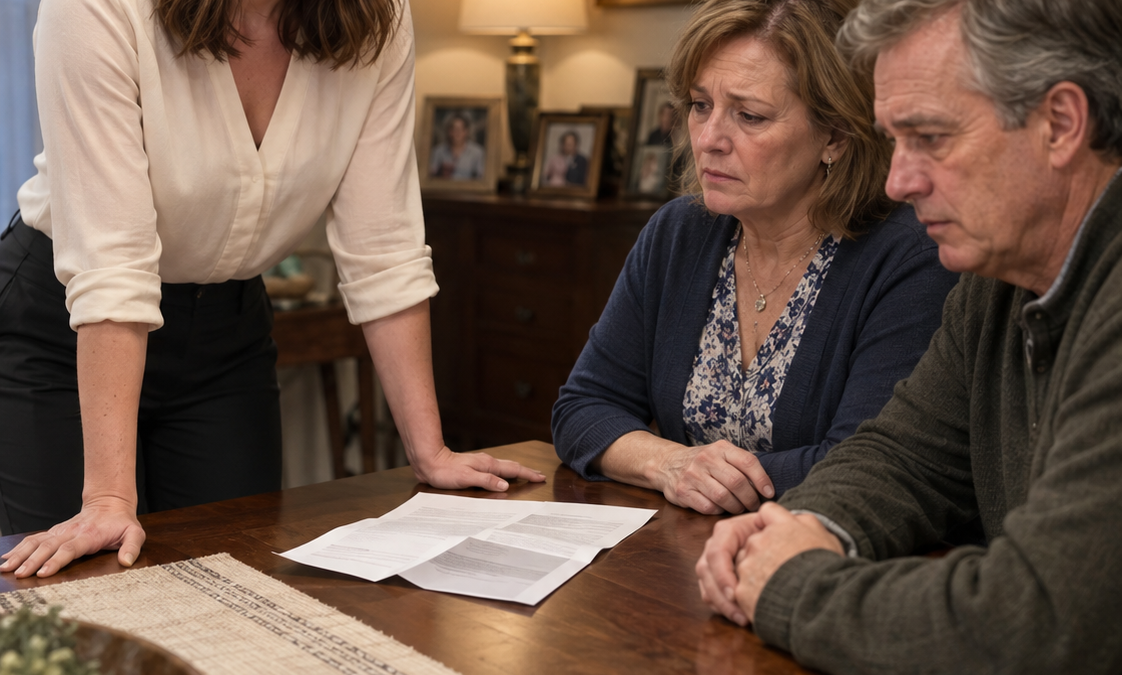
I flattened the letter and slid it toward them.
Mom picked it up.
“What is this?”
Then she read it.
Color rose into her face.
Dad leaned over.
His reaction was quick.
First recognition.
Then an attempt to look unconcerned.
“Oh. That.”
I almost laughed.
“That?”
He waved one hand.
“We needed some of it for family expenses.”
“Some?”
I pointed at the balance.
“There is nothing left.”
Mom shifted in her chair.
“We didn’t take it like that.”
“How exactly did you take it?”
“We used it for important things.”
“What things?”
Neither answered immediately.
So I said the name.
“Jessica?”
Mom went still.
Dad spoke first.
“It wasn’t only Jessica.”
That was not a denial.
“What did you pay for?”
He began listing things.
Private school.
Trips connected to her activities.
Her car.
Expenses intended to give her opportunities.
I sat there listening to my future being described as though it had been an unused family coupon.
“Opportunities?”
My voice rose.
“What about mine?”
Mom tried to calm me.
“You’ve always been responsible.”
I stared at her.
“We knew you would be okay.”
Then came the explanation that finally broke whatever belief I still had that this had been an accident.
“Jessica needed more help.”
I leaned back.
So that was it.
My independence had not protected me.
It had made me easier to take from.
Because I worked hard and managed money responsibly, they assumed I could survive losing what my grandparents left me.
Jessica, in their minds, needed rescuing.
Therefore my future became available.
“This isn’t about being responsible,” I said.
“It’s about trust.”
Neither spoke.
“Grandma and Grandpa trusted you to protect that money for me.”
Dad looked down.
“You betrayed that trust.”
I swallowed.
“And you stole from me.”
Dad flinched at the word.
He did not deny it.
“We were trying to do what was best for the family.”
“No.”
My voice became cold.
“You did what was best for Jessica.”
Mom looked close to tears.
“We thought you would understand.”
“Understand what?”
I pushed my chair back.
“That you gave my future away without asking me?”
I stood.
Mom reached toward me.
I stepped back.
“No.”
The word surprised even me with how firm it sounded.
“This conversation isn’t over. But I need to leave before I say something I regret.”
I drove home furious.
Yet beneath the anger was something steadier.
They had made choices for me.
Now I would make my own.
The following evening, I returned.
I still believed they were hiding details.
Mom was pacing in the kitchen.
Dad sat rigidly on the couch.
Jessica was not there.
Good.
I was not ready for her.
“We’re finishing this conversation.”
Mom sighed.
“Lauren, we already told you. We used it for important things.”
“Tell me exactly where the money went.”
She twisted a dish towel in her hands.
“Things Jessica needed to succeed.”
I laughed once.
“Jessica needed to succeed?”
“What about me?”
Dad intervened.
“You’ve always been independent.”
“There it is again.”
They looked at me.
“Because I’m independent, my future matters less?”
“No one said that.”
“You didn’t have to.”
Over the next hour, the full picture came out.
The trust had been drained gradually.
Jessica’s private-school tuition.
Paid from my trust.
Luxury trips they described as necessary for her to unwind or support activities.
Paid from my trust.
Designer clothes and accessories.
My trust.
Extravagant birthday celebrations.
My trust.
Her new car.
My trust.
Mom defended it.
“Jessica has big dreams.”
Apparently she wanted to build a career in fashion.
Mom believed appearances mattered in that industry.
“So you financed the appearance with my money.”
Mom’s eyes filled.
“We were supporting her.”
“And you were sacrificing me.”
Dad became defensive.
“We didn’t spend it on ourselves.”
“That makes it worse.”
He frowned.
“You gave my future to somebody else and didn’t even ask me.”
Silence.
That night, I decided I needed help.
Not another family conversation.
Professional help.
The following morning, I called Monica.
She was an experienced attorney who had known my family years earlier and had built a reputation handling complex financial disputes.
My hands shook while I explained what happened.
“They emptied the trust.”
I tried to keep my voice steady.
“All of it.”
Monica went quiet.
Then she asked:
“Do you have the original trust agreement?”
“I think so.”
“Find it.”
Her voice was calm.
“Then collect every statement you can. Bank records. Withdrawal history. Receipts. Anything showing what the money funded.”
She paused.
“And if Jessica documents her spending online, preserve that too.”
For the first time since opening the bank letter, I felt a small amount of hope.
I searched my closet.
Eventually I found the old folder my grandparents had given me.
The trust agreement was inside.
I read it slowly.
The purpose was explicit.
The funds existed for my benefit.
My education.
My future plans.
Nothing in the document said the money could be redirected to improve Jessica’s lifestyle.
I sent it to Monica.
Then I began building the timeline.
Bank statements.
Withdrawal dates.
Receipts I could identify.
Jessica’s posts.
A major withdrawal lined up with her new car.
Another with designer purchases.
Another with travel.
The more I looked, the clearer the pattern became.
Monica called after reviewing the first batch.
“This is strong.”
I sat straighter.
“How strong?”
“Strong enough that they are going to have difficulty explaining it.”
She explained the basic issue.
My parents had been trusted to administer money established for me.
They had used it for purposes unrelated to me.
The trust language did not give them unlimited discretion to fund another child’s lifestyle.
When Monica said the word court, I felt cold.
“These are my parents.”
“I know.”
She didn’t soften her tone.
“That doesn’t erase what happened.”
We continued gathering evidence.
More records arrived.
The withdrawals were not random.
They tracked major moments in Jessica’s life.
Tuition.
Shopping.
Travel.
Her luxury car.
And then there was Jessica’s own social-media feed.
It was practically a catalog.
Designer items.
Hotels.
Trips abroad.
Photos on a yacht.
Her new vehicle.
The dates aligned disturbingly well with the trust withdrawals.
Monica preserved screenshots.
“This is useful.”
Looking through those posts hurt.
I remembered liking some of them when they first appeared.
Congratulating Jessica.
Assuming she was doing well.
I had unknowingly been cheering for purchases financed by money meant for my future.
Eventually Monica obtained additional records.
They showed that the bank had warned my parents about restrictions connected to the trust.
More than once.
They continued anyway.
That changed everything emotionally for me.
It meant this was not simply confusion.
They had been told there were limits.
They had decided the limits did not matter.
Monica prepared a formal demand.
The day it reached my parents, Mom called almost immediately.
“Lauren, what is this?”
“You know what it is.”
“Are you really doing this?”
“Yes.”
Her voice cracked.
“We’re family.”
“Families don’t take each other’s money either.”
“We were helping Jessica.”
“And you never asked me.”
Mom returned to the same explanation.
I was responsible.
Independent.
I would have been fine.
“You don’t know that.”
I kept my voice level.
“You never even bothered to ask.”
Dad called next.
His approach was different.
Calm.
Measured.
“Let’s be reasonable.”
I almost smiled.
Reasonable had always meant agreeing with him.
“You really want this in court?”
“If that’s what it takes.”
“Think about what this will do to the family.”
“I have.”
He sighed.
“Jessica is your sister. You should want her to succeed.”
“I should be allowed to succeed too.”
Then he called me selfish.
That was the moment the guilt finally stopped working.
“No, Dad.”
I kept my voice calm.
“You and Mom damaged this family when you took money that wasn’t yours.”
After that, the calls came constantly.
Mom pleaded.
Dad lectured.
Relatives began hearing their version.
Then Jessica called.
“Why are you doing this?”
“Doing what?”
“Making everything into such a huge problem.”
I almost couldn’t believe the sentence.
“They emptied my trust fund for you.”
“It’s just money.”
I went silent.
Jessica continued.
“You’ll earn more. You’ve always been practical.”
There was contempt in the word practical.
“Meanwhile, I have a reputation to maintain.”
That finally clarified everything.
“You think maintaining appearances justified using money that belonged to me?”
She dismissed the question.
She called me selfish.
Said I was tearing the family apart.
“No.”
I stepped closer to the phone as though she could see me.
“Selfish is benefiting from money that isn’t yours and then blaming me for objecting.”
She hung up angry.
The case moved forward.
By then Monica had assembled a detailed record.
Trust documents.
Bank records.
Warnings from the bank.
Receipts.
Transaction histories.
Social-media posts.
The evidence told one consistent story.
My parents had systematically spent money set aside for me on Jessica.
The day we entered the courtroom, my parents sat on one side with their attorney.
Mom looked pale.
Dad avoided my eyes.
Jessica was not there.
Their lawyer argued that they were loving parents who had made mistakes while trying to help their family.
No malicious intent.
No personal enrichment.
Just poor judgment.
Then Monica stood.
Her voice remained calm.
“This is not about a misunderstanding.”
She began with the trust agreement.
The language identifying me as the beneficiary.
The limits on the funds.
Then came the withdrawal history.
Small at first.
Larger later.
Until the balance reached zero.
Next came the expenditures.
Tuition.
Designer goods.
International travel.
Hotels.
Jessica’s car.
None of it was for me.
Then Monica showed the public posts.
Jessica smiling beside expensive purchases.
Travel photos.
The car.
The dates.
The withdrawals.
The relationship was difficult to ignore.
The most damaging evidence came from the bank records confirming that my parents had been warned about the account restrictions.
They proceeded anyway.
When Dad was questioned about why trust funds intended for my future had paid for luxury travel, he struggled to answer.
Mom repeated that everything had been done for Jessica.
Monica asked the obvious question.
“Did you ever consider that helping one daughter this way came directly at the expense of the other daughter’s future?”
Mom looked down.
By the end, the court ruled in my favor.
My parents were ordered to restore the full amount taken from the trust.
There were additional damages connected to the breach of their responsibilities.
When I heard the ruling, I did not feel triumphant.
I felt relieved.
The distinction mattered.
I had not wanted to destroy my parents.
I wanted the future my grandparents intended for me to stop being treated as optional.
The trust was restored.
But our family was not.
My parents contacted me occasionally afterward.
Usually with conversations designed to drift toward normalcy without fully acknowledging what had happened.
I kept my distance.
Jessica sent long messages about how the lawsuit had damaged her life.
I rarely answered.
Her messages focused mostly on what the consequences had cost her.
Not what the original choices had cost me.
I began rebuilding.
The first dream I returned to was graduate school.
For months, the betrayal had pushed that goal aside.
Now I researched programs again.
Contacted admissions offices.
Prepared applications.
When my acceptance letter eventually arrived, I sat at my kitchen table and cried.
Not because of what I had lost.
Because I could finally use the trust for what my grandparents had imagined.
My future.
I also built a life outside the family conflict.
Friends became more important.
Mentors.
People who cared about me without turning support into obligation.
I returned to hobbies I had neglected.
Painting.
Hiking.
Even a cooking class that taught me almost as much about laughing at myself as it did about food.
Slowly, I stopped waking up with the betrayal as my first thought.
The trust had been restored.
More importantly, so had something inside me.
About a year after the case, I received an invitation to speak at a local event focused on financial literacy and protecting personal rights.
The idea terrified me.
Then I realized my story might matter beyond my family.
So I accepted.
When I walked onto the stage, I told the audience about my grandparents.
About the trust.
About what happened when the people entrusted to protect something decided they knew better than the person it belonged to.
I talked about documents.
Boundaries.
Financial awareness.
But mostly I talked about accountability.
“Family can be a source of love and support,” I told them.
“But family is not above accountability.”
The room stayed quiet.
“Protecting your future is not selfish.”
That was the lesson I had taken the longest to learn.
For years, my parents had treated my independence as evidence that I needed less.
Jessica’s demands were always urgent.
My plans could wait.
My savings could be repurposed.
My future could be postponed.
Until I finally said no.
When the event ended, several people came to speak with me.
Some had their own stories.
Educational savings used without permission.
Family members making financial decisions for them.
Money and guilt tangled together until they could no longer tell where love ended and obligation began.
Driving home that night, I thought about the woman I had been when I opened that first bank letter.
She felt powerless.
Her future had been emptied from an account while she wasn’t looking.
I wasn’t that woman anymore.
What my parents had done would always be part of my history.
It would not be the definition of my life.
The money mattered.
But the larger thing I recovered was the right to decide that my future mattered too.