My sister announced in our family group chat that I “didn’t fit the vibe” for Christmas, and no one defended me—even though I had spent months preparing my own home to host everyone
“She doesn’t fit the vibe.”
Maddie wrote it in the family group chat as casually as if she were commenting on the weather.
Three laughing emojis followed.
Then came a photograph of matching Christmas pajamas laid neatly across her bed.
For almost two minutes, I stared at the screen.
I was waiting for somebody to say something.
Anything.
Mom could have asked what Maddie meant.
Dad could have told her that wasn’t funny.
Aunt Lorraine normally reacted to every message within seconds. Even one confused question from her would have been something.
Instead, there was silence.
Then Dad sent a thumbs-up.
That was the moment it became real.
My name wasn’t in Maddie’s message.
It didn’t need to be.
Everyone knew who “she” was.
Me.
Sarah.
Thirty-eight years old, and apparently no longer suitable for my own family’s Christmas.
I locked my phone and placed it face down on the kitchen counter.
Gingerbread cookie dough was spread out in front of me.
I had been preparing it for the holiday gathering.
For months, I had been preparing everything.
It was supposed to be my turn to host.
I had renovated the downstairs bathroom.
Repainted the guest rooms.
Bought an artificial Christmas tree tall enough to nearly touch the ceiling because Mom’s allergies made a real tree difficult.
Back in October, I had asked everyone if staying at my place would work better that year.
Flights were expensive.
Rental prices had increased.
My house had space.
Everyone agreed.
Even Maddie.
At least to my face.
Apparently, somewhere between October and December, she decided that Christmas needed to happen another way.
And instead of speaking to me directly, she used the family group chat as her stage.
Maddie had always been good at that.
She knew how to make a cutting remark sound playful.
How to say something mean enough to land, but casual enough that objecting made you look humorless.
If I reacted, I became the emotional sister.
The bitter one.
The one who made everything uncomfortable.
So I didn’t reply.
Later that evening, I reopened the group chat.
There had been more messages.
Mom had written:
“We’ll miss you there, sweetie. Hope you can make time for a quick dinner before we leave.”
That was worse.
Maddie had drawn the line.
Everyone else had quietly accepted it.
And now Mom was writing as though I had simply chosen not to participate.
I stared at the screen.
Then I put the phone down.
What I needed wasn’t an argument.
It was twenty quiet minutes and the admin dashboard for my front-door access system.
The year before, I had installed smart locks.
Family members and a few close friends had key cards that allowed them to enter without needing me home.
Maddie had one.
My parents had one.
Aunt Lorraine had one.
I’d even written their names on the backs in silver marker.
At the time, it had felt generous.
Convenient.
Welcoming.
Now it felt different.
I opened my laptop.
Selected Maddie’s name.
Deactivated her card.
No announcement.
No angry message.
No warning.
One click.
Access removed.
I leaned back in my chair.
Maybe it was petty.
But what I felt wasn’t triumph.
It was the first full breath I’d taken in weeks.
For most of my life, I had been the daughter who made things easier.
The reliable one.
The one who could handle disappointment.
The one who didn’t need much attention.
Maddie had always occupied the opposite role.
She walked into a room and somehow became its center.
Every bad decision became a story.
Every outburst was excused.
Every mess came with an explanation.
“That’s just Maddie.”
I heard that sentence constantly.
When I was upset, I was told to be patient.
When Maddie was upset, the whole room reorganized around her.
I convinced myself for years that this made me stronger.
I was low-maintenance.
Independent.
Reasonable.
But there was another way to describe what I had become.
Easy to ignore.
The next morning, Maddie texted.
“Can you bring my hiking boots to Vermont? Left them in the mudroom.”
No “please.”
No acknowledgment of the group-chat message.
No apology.
Just the assumption that even though I was no longer welcome for Christmas, I would still perform errands for the people who were going.
Dad texted soon afterward.
“Heard you’re not coming. That’s disappointing.”
I read it twice.
Apparently, I’d declined an invitation that didn’t exist.
I answered neither message.
I made coffee.
Sat at the kitchen table.
Watched cold December rain streak down the windows.
The quiet felt strange.
Then memories started surfacing.
The previous Christmas, Maddie had arrived two days early without warning.
She brought a boyfriend nobody knew was coming.
They treated the guest room like a hotel suite.
Used whatever they needed.
Created extra work.
Forgot to contribute for groceries.
I smiled through all of it.
That was my role.
The more I remembered, the less angry I became.
By the time the family’s flight left, I had changed the security settings so I would receive an alert if Maddie’s deactivated card was used.
I didn’t expect her to return early.
But something told me I should know if she tried.
For several days, nothing happened.
The house stayed quiet.
I moved through rooms I’d spent months preparing for guests who never arrived.
Fresh paint.
Clean sheets.
A tree glowing in a living room no family member was coming to see.
At first, the emptiness felt humiliating.
Then it started feeling peaceful.
On the third morning, at exactly 7:12, my phone chimed.
Access denied.
Card 004.
Maddie.
Three failed attempts.
I stared at the notification.
She had returned.
And she believed her key still worked.
That belief told me almost everything I needed to know.
She had excluded me from Christmas.
But she still expected access to my house.
My storage space.
My belongings.
My convenience.
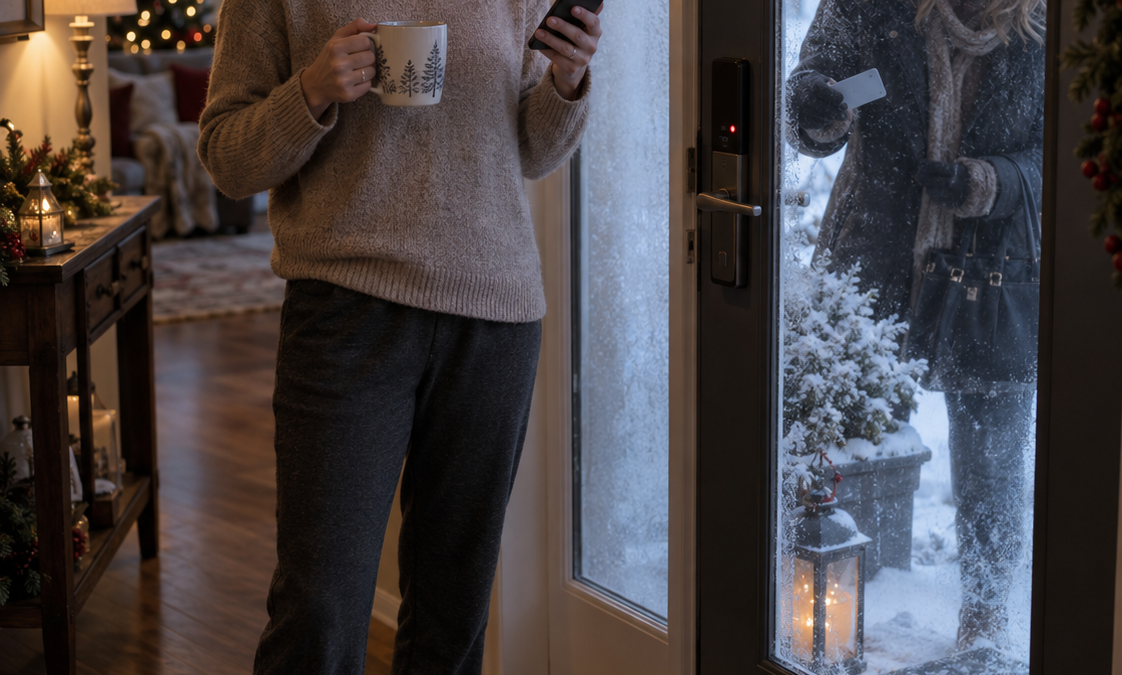
Through the frosted glass beside the front door, I could see her moving impatiently on the porch.
My coffee was warm between my hands.
Then she knocked.
Not a hesitant knock.
A sharp, familiar knock.
The kind you use when you assume the person inside is obligated to answer.
My phone buzzed.
“Hey, I think your lock is broken. Tried my card and it’s blinking red. Can you check?”
I almost laughed.
Not one word suggested that she considered the possibility that the card had been intentionally disabled.
I waited.
She tried again.
Red light.
Denied.
Then I finally typed back.
“Nope. It works fine.”
I could see her through the glass when she read it.
Her shoulders straightened.
She looked at the card.
Then the door.
Then tried again.
Red.
Denied.
Another knock came.
Softer.
“Sarah, come on. I need to grab my boots. Just let me in real quick.”
I didn’t move.
Eventually, the knocking stopped.
The security-camera notification showed her walking away from the porch.
Less than an hour later, Mom called.
I let it go to voicemail.
“Sarah, Maddie says you wouldn’t let her in. She’s really upset. She just wanted her things. Can you call her?”
I listened to the whole message.
Then deleted it.
There had been a time when I would have called immediately.
Explained everything.
Softened it.
Apologized for making anyone uncomfortable.
That version of me had spent years cleaning up emotional messes she hadn’t created.
I was done.
The smart lock wasn’t malfunctioning.
The family dynamic was.
And for once, I wasn’t going to repair it for them.
Still, seeing the access cards sitting in their little metal container bothered me.
There were six.
Maddie’s was disabled.
My parents had one.
Aunt Lorraine had another.
The rest belonged to people who no longer had any real reason to enter my home.
I turned the cards over in my hands.
Every one represented access I had given automatically.
Not because it was necessary.
Because making life easy for everyone else had become instinctive.
That evening, I removed the remaining unnecessary access.
My parents’ card too.
No dramatic announcement.
My home simply stopped being a place people could enter without asking.
Then I invited Mom and Dad to dinner.
Not to apologize.
To talk.
They arrived a few days later.
I cooked.
Set the table.
We made it halfway through the meal before I said anything important.
“I deactivated the spare keys.”
Mom stopped eating.
“All of them?”
“Yes.”
Dad looked up.
“I don’t want people coming into my house without asking anymore.”
Neither said anything.
“This is my home. I’ve treated it like a revolving door because nobody ever had to think about whether access was still welcome.”
Dad cleared his throat.
“Maddie didn’t mean any harm.”
I nodded.
“I know.”
Then I added:
“She never does. That’s the problem.”
Dad looked at me.
“No one tells her when she crosses a line because everyone’s afraid of upsetting her. So I become the person who absorbs whatever happens.”
The room went quiet.
For once, I didn’t rescue anyone from the silence.
Mom eventually said:
“You could have just told her.”
I laughed softly.
“Told her what?”
Mom looked uncomfortable.
“That I don’t like being erased from my own family? That it hurts when she mocks me and nobody says anything? That I’ve tried telling you for years?”
Mom looked down.
“Every time I said something, you told me to let it go.”
Dad reached for his water.
“So I did,” I continued. “Until I didn’t.”
They left quietly after dinner.
There was no dramatic reconciliation.
No apology that fixed everything.
Just awkward goodbyes and the sense that something fundamental had shifted.
Maddie responded publicly.
A vague social-media post appeared the next day.
Something about people building walls instead of bridges.
I almost wrote something back.
Something sharp.
Then I closed the app.
I didn’t need to fight her version of events.
My boundary didn’t require public approval.
The door was locked.
That was enough.
As Christmas Eve approached, my house became different.
Not empty.
Mine.
The quiet no longer felt like evidence that I’d been abandoned.
It felt intentional.
So I hosted dinner after all.
Just not for my family.
Ashley from work came carrying homemade bread and mismatched containers.
Daniel, a friend I’d met at the dog park, brought a store-bought pie and his young daughter.
Maya, my yoga instructor, joined us after admitting she otherwise would have spent the holiday alone.
Nothing matched.
There were no coordinated pajamas.
No staged holiday photographs.
No carefully curated “vibe.”
Someone told a story that ran ten minutes too long.
Someone spilled a drink.
We cleaned it up and kept laughing.
Nobody made passive-aggressive jokes.
Nobody expected me to disappear so another person could stay comfortable.
For the first time in years, I wasn’t scanning a room for the next problem.
I was simply inside it.
Present.
After midnight, someone knocked.
The sound was different this time.
Slow.
Uncertain.
I knew who it was before I opened the door.
Maddie stood on the porch wearing a heavy coat and knit hat.
For a few seconds, neither of us spoke.
She looked smaller than usual.
Not physically.
Something about her posture.
The performance was missing.
“I didn’t come to fight,” she said.
I waited.
“I wanted to say… I get it.”
She paused.
“Not all of it. But some of it.”
Another pause.
“I’m sorry.”
I didn’t invite her inside.
But I didn’t close the door either.
“I miss you,” she added quietly. “They all do.”
Maybe she meant it.
Maybe she didn’t fully understand yet.
Maybe my absence had become inconvenient enough that everyone wanted the old arrangement restored.
I couldn’t know.
“I spent thirty-eight years being the quiet one,” I told her.
She watched me.
“And nobody noticed how loud it got inside me.”
Her face changed slightly.
“If you’re really here because of me, not because you want everything to go back to normal, then you can give me some time.”
Maddie nodded.
There were no tears.
No dramatic speech.
No angry exit.
She stood there for another moment.
Then turned and walked away.
I closed the door.
Locked it.
Behind me, laughter was already filling the kitchen again.
Someone asked where the extra napkins were.
Someone else was cutting pie.
The warmth inside hadn’t disappeared because Maddie had shown up.
That mattered.
Later, after everyone left and the dishes were washed, I sat alone.
The house was quiet again.
But quiet no longer felt like punishment.
It felt like choice.
Maybe one day Maddie and I would learn how to speak to each other without repeating the same old roles.
Maybe one day the door would open again.
But if it did, it would open because I chose to open it.
Not because guilt demanded it.
Not because habit expected it.
And not because being the “easy daughter” required me to disappear again.
For now, the silence belonged to me.
And for the first time, I wasn’t afraid of it.