On Christmas Eve, My Adult Children Took the Only Six Seats Left to St. Thomas and Left Me Alone at the Atlanta Airport—Even Though I Had Paid for Their Flights and the Villa—Because My Son Said, “Mom Can Afford Another Ticket,” as if Being Wealthy Meant I Was the Easiest Person in the Family to Leave Behind
Marcus never looked at me when he decided I would be the one left behind.
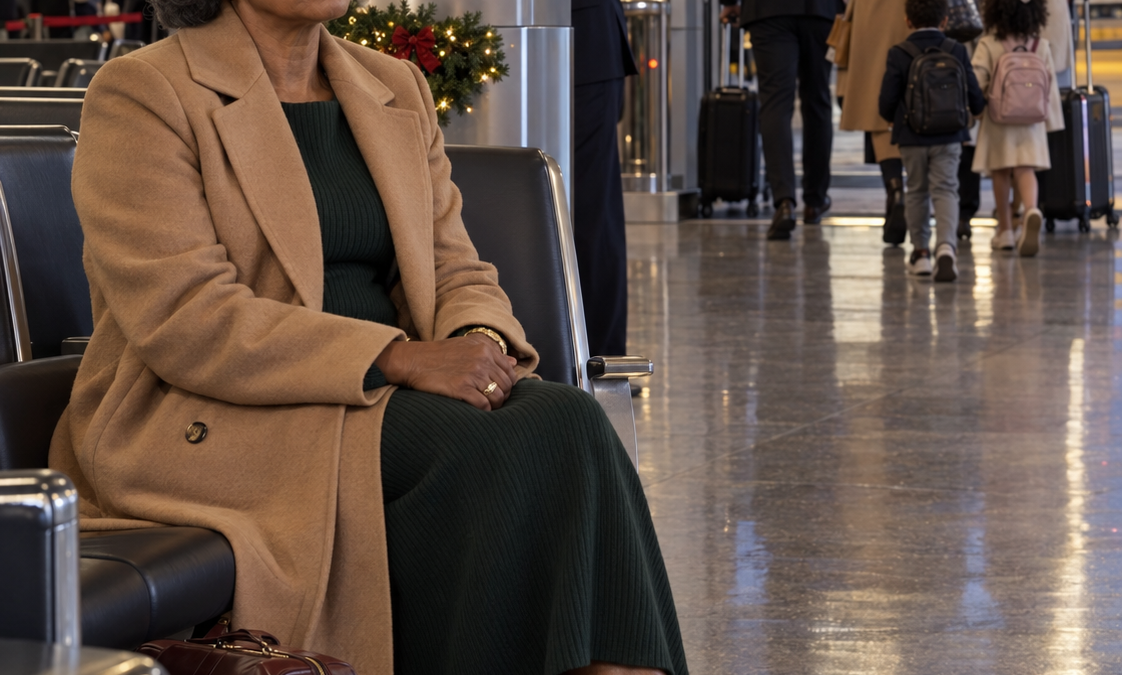
He kept his eyes on the departure board above Gate B27 at Hartsfield-Jackson Atlanta International Airport, where our flight number had just vanished beneath a red weather advisory.
Around us, Christmas Eve had turned the terminal into a strange combination of celebration and exhaustion. Garland looped around the airline counters. Children in matching pajamas slept across their parents’ laps. A recorded piano version of “Have Yourself a Merry Little Christmas” floated from somewhere near the food court while three hundred stranded travelers stared at their phones.
Our flight to St. Thomas had been canceled after a mechanical delay pushed us into a line of thunderstorms moving across the Caribbean routes.
The airline had found six seats on another carrier leaving in forty minutes.
There were seven of us.
My son Marcus stood at the counter with his wife, Paige, and their two children. My daughter Rochelle stood beside them with her carry-on already strapped across her chest.
I stood a few feet away with one burgundy suitcase.
Marcus rubbed the side of his jaw.
“The kids need to get there,” he said.
I waited.
“Obviously Paige goes with them.”
I kept waiting.
“Rochelle’s bag is already checked through.”
That was when I understood what he was doing.
Not discussing.
Explaining.
“There are six seats,” I said.
“I know.”
“And seven people.”
He finally turned toward me.
“Mom, you can just take the morning flight.”
The words were delivered in the same tone he used when suggesting a later dinner reservation.
It was Christmas Eve.
For six months, I had been organizing this trip because none of us knew what to do with Christmas after James died.
My husband had loved December with an almost embarrassing enthusiasm.
He put lights around trees nobody could see from the road. He bought wrapping paper in July. He insisted on making pancakes shaped like snowmen for grandchildren who immediately destroyed them with syrup.
Cancer took him in February.
By June, every family conversation about the holidays ended the same way.
Silence.
Then somebody changing the subject.
So I suggested St. Thomas.
Not because we needed a luxury vacation.
Because I could not bear the thought of all of us sitting in my Atlanta house pretending the empty chair at the end of the dining table was not there.
I rented a four-bedroom villa overlooking the water.
I bought seven round-trip tickets.
I arranged airport transfers, groceries, dinner reservations, and a Christmas Day boat excursion for the children.
The total cost never bothered me.
I was sixty-six years old. I had spent thirty-two years building Carter Health Strategies from a two-person consulting office into a regional company serving hospital systems in four states. Three years earlier, I sold my controlling interest.
I had more money than I needed.
My children knew that.
What I did not know was how thoroughly they had started using that fact to make decisions about what I should tolerate.
Rochelle touched my elbow.
“It’s one night, Mom.”
I looked at her.
“Then stay with me.”
Her fingers dropped away.
She glanced toward the rebooking counter.
“Why would two of us stay?”
That answer told me more than she intended.
My granddaughter Nia, who was eight, stood between Marcus and Paige holding a stuffed sea turtle I had bought her twenty minutes earlier.
She looked up at her father.
“Grandma isn’t coming?”
Marcus crouched.
“Grandma’s coming tomorrow.”
“Why?”
“Because there aren’t enough seats.”
Nia frowned.
“Then I can stay.”
Paige immediately took her hand.
“No, sweetheart.”
It happened so quickly that I almost missed the meaning of it.
An eight-year-old had understood the moral problem before any of the adults had.
Marcus stood.
“Mom, this is getting dramatic.”
“I haven’t said anything dramatic.”
“You’re looking at us like we’re abandoning you.”
I glanced toward the boarding door.
“Aren’t you?”
He exhaled.
“You can buy another ticket.”
There it was.
Simple.
Practical.
Final.
“You have more flexibility than anybody here,” he continued. “You can get a suite. You can fly first class tomorrow. You can hire a car if you want. The kids have been looking forward to this for months.”
“So have I.”
“I know, but you’re not stranded.”
I looked around at the crowded terminal.
“What would you call it?”
Marcus’s face tightened.
Rochelle stepped in.
“Can we please not ruin Christmas over logistics?”
That sentence landed differently.
Apparently Christmas could survive leaving me alone in an airport.
It just could not survive my objecting to it.
The gate agent announced final boarding.
Everything accelerated.
Backpacks were lifted.
Passports checked.
Paige hugged me.
“I’m sorry. It’s just the most sensible arrangement.”
Rochelle kissed my cheek.
“You’ll probably beat us to the beach tomorrow.”
Marcus hugged me last.
He smelled like the cedar aftershave I had given him on his birthday.
“Text when you get somewhere.”
Then he picked up his backpack and walked toward the jet bridge.
Nia turned around.
Once.
Twice.
The adults never did.
I remained beside the gate until the boarding door closed.
Only after the plane pushed away did I notice the man standing near the neighboring podium.
He was in his early fifties, tall, with close-cropped gray at his temples and four gold stripes on the sleeves of his navy jacket.
A pilot.
He had been speaking with another employee when my family was rebooked.
Now he approached without the artificial cheerfulness people sometimes use around older women who are alone.
“Ma’am?”
“Yes?”
“I’m Daniel Reed.”
He gestured toward the closed gate.
“Are you traveling alone now?”
“I suppose I am.”
“Do you have somewhere to stay tonight?”
I almost smiled.
“I can afford a hotel.”
He nodded once.
“I didn’t ask whether you could afford one.”
That stopped me.
He pointed toward the service desk.
“Hotels around the airport are almost full. My crew just got rooms assigned because our Raleigh flight moved to tomorrow morning. Let me see whether there’s anything left before you head downstairs.”
“You don’t have to do that.”
“I know.”
There was nothing dramatic in his voice.
That was probably why I followed him.
The agent at the desk searched.
“Public inventory is gone.”
Daniel leaned closer.
“What about crew block releases?”
She typed again.
“One room came back five minutes ago.”
“Can you hold it?”
“For crew?”
“For her.”
The agent hesitated.
Daniel looked at me.
“You’re paying for it?”
“Of course.”
He looked back at the agent.
“Then put the reservation under her name before somebody else takes it.”
The room was at an airport hotel less than a mile away.
I paid the holiday rate without blinking.
Daniel wrote the shuttle number on the back of an old boarding pass.
“There.”
I took it.
“Thank you.”
“Merry Christmas, Ms. Carter.”
“You too, Captain Reed.”
He started to walk away.
“Captain?”
He turned.
“Why did you stop?”
He seemed surprised by the question.
“Because you were sitting alone beside a closed gate on Christmas Eve.”
That was all.
No lesson.
No curiosity about my money.
No recognition.
No secret connection.
A stranger had simply noticed that being capable of taking care of myself did not mean I should have been left to do it.
I carried that thought with me to the hotel.
My room faced the airport road.
From the twelfth floor, I could watch headlights moving beneath red and green lights wrapped around the entrance canopy.
I ordered tea and tomato soup from room service.
Then I took off my shoes, set them neatly beside the bed, and opened the family group chat.
Photos had already started arriving.
Nia eating pretzels.
My grandson Jordan making a face at the camera.
Paige holding up a plastic cup.
Rochelle photographing the wing.
Then Paige wrote:
Thank goodness we didn’t have to drag Mom through another connection tonight.
I stared at the screen.
Marcus responded:
She’s fine. Mom has money. She can solve anything.
Rochelle added a heart emoji.
That hurt more than I expected.
Not because the words were vicious.
Because they were casual.
Nobody thought they had said anything wrong.
I scrolled upward.
Over the years, the family chat had become a quiet record of what everyone assumed I would handle.
Mom, can you reserve the beach house?
Mom, the kids’ camp deposit is due.
Mom, can you cover Christmas dinner and we’ll Venmo you?
Mom, the rental SUV is bigger if we use your status.
Mom, can we put the villa on your card so we get the insurance?
Individually, none of it had bothered me.
I loved my children.
I loved my grandchildren.
James and I had always believed that money was most useful when it made life easier for people you cared about.
But there had been another category of message too.
Mom will understand.
Mom doesn’t mind.
Mom can change her schedule.
Mom can drive separately.
Mom can take the other room.
Mom can pay the difference.
Mom can afford it.
Somewhere along the way, my flexibility had become an obligation.
My resources had become an excuse not to consider my preferences.
And I had helped teach them that.
That was the part I could not avoid.
I had said yes too quickly for years.
After James died, it became worse.
Whenever the children asked for something, giving it to them made me feel connected to the family rhythm I had lost.
A summer rental.
A college account.
A last-minute flight.
A new refrigerator when Marcus and Paige renovated their kitchen.
I told myself generosity was love.
Sometimes it was.
Sometimes it was fear.
At 11:48 p.m., the hotel phone rang.
The front desk clerk said, “Ms. Carter? Captain Reed asked us to let you know his crew arrived safely. He wished you a peaceful Christmas.”
I thanked her.
Then I turned my cell phone facedown.
I slept better than I expected.
At 7:30 Christmas morning, I woke to sunlight coming through the curtains.
For a few seconds I forgot where I was.
Then I saw my suitcase beside the desk.
The whole evening returned at once.
I made coffee.
At 8:12, Marcus called.
I let it ring twice before answering.
His face appeared against an almost offensively beautiful background.
Blue sky.
White walls.
Palm leaves moving behind him.
“Merry Christmas, Mom.”
“Merry Christmas.”
“You sleep okay?”
“Yes.”
“Good.”
He smiled.
Then Paige leaned into the frame.
“Small issue.”
I almost laughed.
Of course.
The villa manager needed a cardholder present for the incidental deposit.
The booking was in my name.
They had my authorization for the rental charge, but the property required a physical card or a new digital authorization for the security hold.
Marcus spoke quickly.
“It’s not a big deal. They’re sending you a link. You just enter your AmEx information again.”
“How much is the hold?”
“Five thousand.”
I took a sip of coffee.
Behind him, I could hear Jordan asking where his swim goggles were.
Marcus kept talking.
“We’re all standing here with the luggage. The kids are tired.”
“I thought they slept on the plane.”
“Mom.”
“What?”
“Can you just do the authorization?”
I looked at him.
The night before, there had been six seats.
He had made a practical decision.
Now there was a five-thousand-dollar hold.
Suddenly practicality required me again.
“Use your card,” I said.
There was a pause.
“My card?”
“Yes.”
“It’s your reservation.”
“The manager can transfer the incidental hold to another guest.”
His expression changed.
“Why would we do that?”
“Because you’re there.”
He lowered his voice.
“Are you seriously doing this because of last night?”
“I’m asking you to put a temporary security hold on your own vacation.”
“You paid for the villa.”
“Yes.”
“So what difference does it make?”
I set down my coffee.
“That question is the difference.”
Paige moved closer.
“Evelyn, we weren’t trying to hurt you.”
“I didn’t say you were.”
“We were trying to get the kids there.”
“And you did.”
Marcus rubbed his forehead.
“My card doesn’t have five thousand available after Christmas shopping.”
“That sounds like something you should discuss with the manager.”
His head snapped up.
“Mom.”
I knew that tone.
It was the tone my children used when I was stepping outside the role they expected me to play.
Not angry enough to start a fight.
Just surprised.
I had been reliable for so long that any boundary looked like a personality change.
Rochelle appeared behind him.
“What’s happening?”
“Mom won’t authorize the deposit.”
Rochelle looked at the screen.
“Seriously?”
I looked at my daughter.
“Yes.”
Her eyebrows rose.
“Because we took the flight?”
“No. Because all of you decided I was the easiest person to leave behind because I could afford to solve the problem later. And this morning, before anyone asked whether I was okay, the first problem you needed me to solve arrived.”
Nobody spoke.
Jordan yelled something from another room.
Paige walked away.
Marcus lowered his voice.
“We’ll talk about this when you get here.”
“I’m not coming.”
That was the first decision I made that morning that surprised even me.
Rochelle leaned toward the phone.
“What do you mean?”
“I mean I’m not flying to St. Thomas today.”
“But everything is booked.”
“For you.”
“Mom, it’s Christmas.”
“I know.”
“Where are you going to go?”
That question almost made me smile.
As though not being with them meant I had nowhere to belong.
“I’ll figure it out.”
Marcus shook his head.
“You’re punishing the grandkids.”
“No.”
“They came here because you planned this.”
“And they should enjoy it. I’m not canceling the villa. I’m not canceling the boat. I’m not canceling Christmas dinner.”
He looked confused.
“Then what are you doing?”
“Staying where I’m wanted.”
I ended the call before I could turn that sentence into a speech.
Then I sat in the quiet hotel room and asked myself where that actually was.
My first thought was my cousin Lorraine.
She lived twenty-five minutes outside Atlanta.
Three weeks earlier, she had invited me to Christmas brunch.
I had declined because of St. Thomas.
I called.
She answered on the second ring.
“Aren’t you supposed to be in the Caribbean?”
“I am supposed to be many places.”
She went quiet.
“What happened?”
I told her.
Not dramatically.
Just the facts.
When I finished, Lorraine said, “I’m sending Curtis.”
“You don’t have to.”
“Evelyn.”
“Yes?”
“You have spent thirty years telling everybody else they don’t have to do things for you. Curtis is coming.”
Her husband picked me up forty minutes later.
I arrived at their house carrying the burgundy suitcase I had packed for five nights on an island.
Lorraine opened the door wearing an apron covered in flour.
Her three adult children were in the kitchen.
Two grandchildren were arguing about cinnamon rolls.
Nobody asked why I was there before taking my coat.
Nobody asked whether I could afford a hotel.
Lorraine handed me a mug.
“Peel potatoes.”
That ordinary instruction almost undid me.
I spent Christmas morning at her kitchen island.
Not as the sponsor.
Not as the organizer.
Not as the person who had already paid.
Just as Evelyn.
My family called four times.
I answered once in the afternoon.
Marcus had found a solution for the deposit. Rochelle put it on her card and the villa manager split the hold.
The world had not ended.
They had eaten lunch.
The children had gone swimming.
The adults had figured something out without me.
That mattered.
I did not enjoy knowing they were angry.
I did not feel triumphant.
I missed Nia and Jordan fiercely.
At one point Lorraine’s grandson asked why I looked sad.
I told him, “Because sometimes doing the right thing for yourself still hurts.”
He accepted that more easily than most adults would have.
My family returned to Atlanta five days later.
Marcus texted that they wanted to stop by.
I said Sunday at two.
At 1:58, both cars pulled into my driveway.
Rochelle came in first.
Marcus followed.
Paige stayed home with the children.
I had made coffee.
Nothing else.
For years, any family discussion at my house came with food.
I would put out fruit, pastries, sandwiches, wine.
I realized that feeding everybody had become another way of softening every difficult conversation before it started.
This time there were three mugs on the kitchen table.
Marcus noticed.
He sat down.
Rochelle remained standing.
“That was a miserable thing to do on Christmas morning,” she said.
I nodded.
“I imagine it felt that way.”
“You embarrassed us at the villa.”
“I wasn’t there.”
“You know what I mean.”
“Yes.”
Marcus folded his arms.
“You could have authorized the card in thirty seconds.”
“I could have.”
“Then why didn’t you?”
I looked at him.
“Because I needed to know whether you could solve one problem without deciding I was responsible for it.”
“That’s ridiculous.”
“Was it?”
“Yes. We weren’t using you.”
I turned toward Rochelle.
“Who paid for your ticket?”
She looked away.
I turned back to Marcus.
“Who paid for the villa?”
He said nothing.
“The airport transfer?”
Silence.
“The boat?”
“Mom, you offered.”
“Yes.”
I let that sit.
“I offered. And because I offered many times, you began treating access to my money as part of the family infrastructure.”
Marcus frowned.
“That’s not fair.”
“No. Leaving me at an airport because I could afford to fix it was not fair.”
Rochelle sat down.
“We had six seats.”
“I know.”
“Somebody had to stay.”
“Yes.”
“Then what were we supposed to do?”
I had thought about that question for five days.
“You were supposed to act like choosing the person who stayed mattered.”
She stared at me.
“You could have asked me whether I wanted to stay. Marcus could have offered. Paige could have offered. We could have put names in a hat. We could have asked the airline whether two of us could travel the next morning. We could have behaved like seven people trying to solve a problem together.”
I looked at Marcus.
“Instead, you looked at my bank account and decided my feelings were the cheapest ones in the room.”
His jaw tightened.
“I never said that.”
“You didn’t have to.”
He stood and walked toward the window.
For a while, nobody spoke.
Then Rochelle said quietly, “I really thought you’d be okay.”
“I was okay.”
That seemed to confuse her.
I continued.
“I got a hotel room. I had Christmas with Lorraine. I ate too many cinnamon rolls. I was safe.”
“Then—”
“Being okay afterward does not make what happened okay.”
She looked down at her hands.
That was the first moment I saw something shift in her.
Not guilt exactly.
Understanding.
Marcus was slower.
He turned from the window.
“What do you want from us?”
I had expected that question.
“I don’t want repayment for the trip.”
His shoulders loosened.
“I’m not changing the grandchildren’s education accounts.”
Rochelle looked relieved.
“I’m not rewriting my will because of one bad Christmas.”
Marcus sat down again.
I continued.
“But I am done financing adult family life by default.”
The relief disappeared.
“What does that mean?” he asked.
“It means future vacations are split by household.”
Rochelle opened her mouth.
I kept going.
“If we go to dinner, I may treat everyone because I want to. Or I may not. If someone needs help, you can ask. I may say yes. I may say no.”
Marcus gave a short laugh.
“So this is about money.”
“No.”
“It sounds like money.”
“It’s about the fact that money has been doing the work of consideration in this family.”
Neither of them responded.
“When I pay, nobody has to ask what I want. When I fix things, nobody has to wonder whether I’m tired. When I can afford another ticket, nobody has to feel bad leaving me behind.”
Marcus stared at the table.
I leaned back.
“I helped create that pattern. I know that. I liked being needed after your father died. I said yes to things before anybody finished asking. That was my mistake.”
Rochelle’s face changed.
“You were lonely.”
“Yes.”
“I didn’t know.”
“I didn’t say it.”
That was the hardest admission of the afternoon.
It would have been easier to make my children entirely responsible.
They were not.
They had become careless.
I had become indispensable on purpose.
Both things could be true.
Marcus finally said, “I’m sorry you were alone.”
I studied him.
It was not the apology I wanted.
Not yet.
But it was closer than anything he had said before.
“I wasn’t alone for long.”
Rochelle gave me a small smile.
“Lorraine?”
“And a pilot.”
Marcus looked up.
“A pilot?”
I told them about Daniel Reed.
Not as a heroic rescue.
Just the hotel room.
The question he asked.
The fact that he had noticed.
When I repeated his words — I didn’t ask whether you could afford one — Marcus looked away.
Rochelle started crying quietly.
I did not rush around the table to comfort her.
That mattered too.
Sometimes another person’s discomfort is simply the place where understanding begins.
Our family did not transform in one afternoon.
Marcus remained defensive for months.
Paige stopped sending me links to rental houses.
Rochelle started calling before assuming I could attend something.
There were awkward restaurant checks.
One birthday dinner where Marcus stared at the bill for several seconds before putting down his own card.
One spring weekend when Rochelle asked if I could watch her dog, then immediately added, “And you can say no.”
I did.
She found a sitter.
Nothing terrible happened.
The first real test came the following November.
Our family group chat began discussing Christmas.
Marcus sent a link to a resort in Puerto Rico.
Then he wrote:
We can all price our own rooms if people want to do this. No pressure.
A minute later Rochelle added:
Mom, what do YOU want to do this year?
I sat at my kitchen table reading the message.
Outside, the maple tree James planted twenty years earlier had gone almost bare.
For the first time in a long time, nobody had handed me a plan and a bill in the same breath.
I typed slowly.
Christmas Eve dinner at my house. Everybody brings something. Christmas morning, I’m sleeping late.
Nia immediately responded:
I’m bringing cinnamon rolls.
I laughed.
On Christmas Eve, they arrived carrying casserole dishes, pie boxes, flowers, and one ugly sweater Marcus insisted James would have loved.
Nobody asked me what anything cost.
Nobody handed me a receipt.
After dinner, Nia curled beside me on the sofa.
At one point Marcus walked over and set a mug of tea on the table beside me.
“You need anything else?”
I looked around the room.
Rochelle was helping Paige wrap leftovers.
Jordan was trying to convince Lorraine’s grandson that he could beat him at cards.
The old chair at the end of the dining table was still empty.
James was still gone.
My family was still imperfect.
So was I.
But nobody had left me behind because they assumed I could purchase my way out of being hurt.
“No,” I told Marcus.
Then I picked up the tea.
“I’m good.”
And this time, when he said okay, he believed me.