On the Christmas Eve Flight I’d Booked Months Ago, Grant Mercer Pointed at My First-Class Seat 2A and Told Me to Move to Row 12 So His Fiancée Could Sit Beside Him—Even Though My Assignment Was Correct and He Refused to Give Up His Own Seat, Because Apparently an Older Woman Traveling Alone Was the Easiest Passenger to Displace.
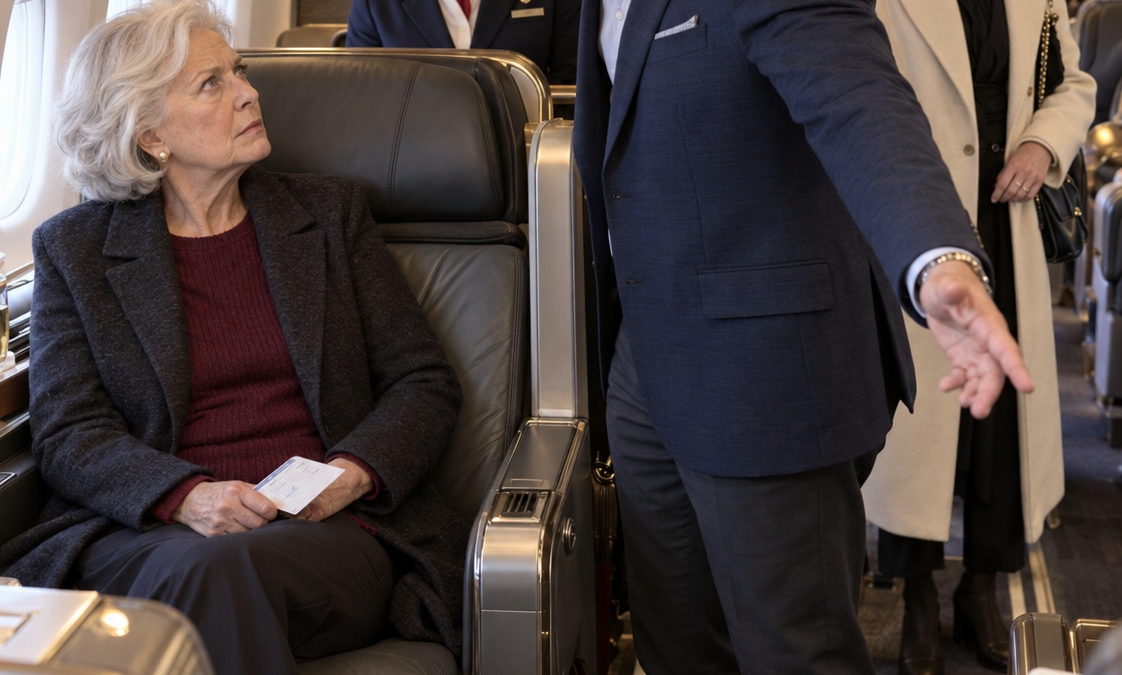
The first thing Grant Mercer did was smile.
Not warmly.
Not nervously.
It was the polished smile of a man who had already decided the answer to his request and was only waiting for me to cooperate.
He stopped beside my seat while passengers were still boarding the Christmas Eve flight from Dallas to Boston.
“Excuse me,” he said.
I looked up from the paperback in my lap.
He was somewhere in his mid-forties, neatly trimmed dark hair beginning to gray at the temples, navy blazer that looked too expensive to have spent much time folded into a suitcase, polished shoes, leather briefcase.
“Yes?”
He pointed casually toward the back of the plane.
“Would you mind moving to 12C? My fiancée is sitting there, and we’d really like to be together.”
I looked at the number above my window.
2A.
Then at my boarding pass.
Also 2A.
“No, thank you.”
I opened my book again.
Grant did not move.
“I don’t think you understand.”
I looked back up.
“She’s traveling with me.”
“I understood.”
“We’re going to Boston for Christmas.”
“So am I.”
The smile weakened.
For the first time, he seemed to actually look at me.
I was seventy-two.
Silver hair.
Reading glasses.
Charcoal travel coat folded across my lap.
One small brown handbag tucked near my feet.
Traveling alone.
I could almost see the calculation that had taken place before he approached me.
Older woman.
Solo traveler.
Probably polite.
Probably flexible.
Probably easier than asking someone his own age.
“I’m just asking for a simple favor,” he said.
“And I said no.”
His eyes flicked toward my boarding pass.
“Is this your assigned seat?”
“Yes.”
“Okay.”
He said it as though that fact was mildly inconvenient rather than decisive.
Then he pointed down the aisle again.
“12C is an aisle seat. It’s a perfectly good seat.”
“Then your fiancée should be comfortable there.”
His mouth tightened.
A woman across the aisle lowered her magazine by half an inch.
She was listening.
So was the man behind us pretending to rearrange his laptop bag.
Grant reached into his jacket pocket.
“I’ll give you two hundred dollars.”
“No.”
“Three hundred.”
“No.”
“Five.”
I stared at him.
“You’ve gone from asking me for a favor to trying to purchase something that isn’t for sale.”
His expression cooled.
“I’m trying to solve a problem.”
“You don’t have a seating problem.”
“My fiancée is in row twelve.”
“That sounds like your seating arrangement.”
He glanced toward the forward galley.
A flight attendant was helping an elderly man place a coat in the closet.
Grant leaned slightly closer.
“She gets nervous flying alone.”
That almost changed my answer.
Almost.
My husband Thomas had hated turbulence.
For forty-three years of marriage, every time an airplane shook, he reached for my hand even though he would later insist he had only been checking whether I was awake.
After he died, I discovered there were dozens of tiny things I had never understood were part of being married until there was nobody beside me doing them anymore.
Someone handing you the hotel key while you carried the suitcase.
Someone knowing you preferred tea to coffee.
Someone asking if you wanted the window before choosing his own seat.
If Grant’s fiancée was truly afraid to fly alone, I could understand why he wanted to sit beside her.
So I asked the obvious question.
“Why don’t you go sit with her?”
He blinked.
“Excuse me?”
“You have a seat here.”
I gestured toward 2C, the aisle seat beside mine.
“Give her your first-class seat. You can take 12C.”
He actually laughed.
Not loudly.
Just one short sound of disbelief.
“I have work to do.”
“Can you work in row twelve?”
“That’s not the point.”
There it was.
I closed my book around one finger.
“What is the point?”
Grant glanced behind him.
“My fiancée and I should be able to sit together.”
“Then sit together in coach.”
He stared at me.
The woman across the aisle stopped pretending to read.
Grant lowered his voice.
“I paid for this seat.”
“So did I.”
“You used miles.”
I was surprised.
“How do you know that?”
He hesitated.
He had probably seen the colored tag on my boarding pass indicating an award ticket.
It was the kind of detail men like Grant noticed because they assumed it told them something about who belonged where.
“Yes,” I said. “I used miles.”
His face relaxed slightly, as if this strengthened his argument.
“So you didn’t exactly pay full price.”
That sentence brought back something my sister Susan had said when I told her I was finally booking the flight.
Use the miles, Ellie. Thomas saved them too. Let him buy you one last nice seat.
Thomas and I had accumulated those miles over twenty years of visiting children, attending weddings, taking two modest vacations a year when we could afford them.
They were not free.
They represented time.
Trips.
Missed connections.
Anniversaries.
The last flight Thomas and I took together had been to Santa Fe six months before he got sick.
He had insisted I sit by the window because the sunset over New Mexico was worth seeing.
I looked at Grant.
“The airline considers the seat paid for.”
His face tightened again.
That was when the flight attendant approached.
She was in her early forties with a calm expression and a name tag that read JANICE.
“Is everything all right here?”
Grant turned toward her immediately.
“Yes. We’re just trying to arrange a seat swap.”
Janice looked at me.
“Ma’am?”
“I’m not swapping.”
Janice nodded.
“Then you’re all set in 2A.”
Grant held up one hand.
“I know she’s assigned here. I’m not disputing that.”
Janice waited.
“My fiancée is in 12C. I’m trying to get us seated together.”
“Seat changes are voluntary, sir.”
“I know.”
“Then Mrs. Price can remain in 2A.”
Grant looked at me.
“I’m asking her to be reasonable.”
Janice’s expression did not change.
“She has answered your request.”
For a few seconds nobody moved.
Then a woman’s voice came from behind him.
“Grant?”
He turned.
She was perhaps thirty-nine, wearing a cream wool coat over black trousers, dark hair pulled into a low knot.
She had the look of someone who had hurried from another boarding group and immediately sensed that something was wrong.
Grant’s whole posture softened.
“Tess. Great. I’m handling it.”
Her eyes moved from him to me.
“Handling what?”
“I’m getting us seated together.”
Tess looked at the number above my head.
2A.
Then at the boarding pass in my hand.
Her expression changed.
“I told you I was fine in twelve.”
Grant smiled as though she had made a joke.
“You shouldn’t have to sit back there while I’m up here.”
“Then switch with me.”
He stopped.
Tess pointed to 2C.
“That’s your seat, right?”
“Yes.”
“So give it to me.”
“That doesn’t solve the problem.”
“What problem?”
“We still wouldn’t be sitting together.”
Tess stared at him.
I suddenly wished I were anywhere else.
Not because I was uncomfortable defending my seat.
Because I had the unpleasant feeling that I was watching an argument that had started long before anyone boarded this airplane.
Grant glanced at me.
Then at Janice.
“This is getting ridiculous.”
Tess folded her arms.
“You came up here and asked her to move?”
“I offered to compensate her.”
“How much?”
“That isn’t relevant.”
“How much?”
Grant exhaled.
“Five hundred.”
Tess looked horrified.
“You offered a stranger five hundred dollars to leave first class so I could sit here?”
“I was trying to do something nice for you.”
“No. You were trying to make someone else do something nice for you.”
The woman across the aisle looked down quickly.
I almost smiled.
Grant’s face flushed.
“Tess, we can discuss this later.”
She did not move.
“I thought you requested both upgrades.”
Grant glanced toward the line of passengers waiting behind her.
“I did.”
“No. You told me you did.”
“I put us on the list.”
“My app never showed it.”
“Tess.”
“Did you request my upgrade?”
His silence was brief.
Too brief for someone who had simply forgotten.
Long enough for her to understand.
She took out her phone.
“I checked three times this afternoon because you told me both names were pending.”
Grant lowered his voice.
“I had one certificate left.”
Tess stared at him.
“What?”
“One upgrade certificate.”
“You said you had two.”
“I thought I did.”
“You thought?”
Grant looked around.
“This is not the place.”
“When were you planning to tell me?”
He rubbed his forehead.
“I figured once I got up here, someone would switch.”
Tess looked at me.
Then back at him.
“You upgraded yourself.”
“It made sense to secure one seat first.”
“And then?”
“I knew I could probably work something out.”
“With somebody else’s seat.”
He said nothing.
That was the real problem.
Not 2A.
Not 12C.
Not first class.
Grant had built a plan in which every inconvenience belonged to someone else.
If two upgrades did not clear, he would keep the good seat.
If Tess wanted to sit with him, another passenger could move.
If that passenger objected, money could make the objection disappear.
At no point in his plan did Grant Mercer become the person who gave anything up.
Janice checked the boarding line.
“We need to get everyone seated.”
Tess looked at Grant.
“Fine.”
He seemed relieved.
“Good.”
“I’ll stay in twelve.”
His relief lasted perhaps one second.
Then she added, “You decide where you’re sitting.”
Grant stared at her.
“I’m already assigned here.”
“I know.”
She turned.
He reached for her arm but stopped before touching her.
“Tess.”
She looked back.
“What?”
“You’re making a scene.”
“No.”
Her voice was remarkably calm.
“I’m giving you the exact choice you expected her to make.”
She nodded toward me.
“If sitting together matters that much, come sit with me.”
Grant’s jaw worked.
“Twelve C isn’t even beside you. Your actual seat is 12C. I’d have to find another passenger willing to move.”
Tess gave him a long look.
“Yes, Grant. That is apparently how assigned seats work.”
Janice pressed her lips together.
I stared out the window so no one would see me smiling.
Grant lowered his voice again.
“I need to be rested when we land.”
“So do I.”
“I have calls tomorrow morning.”
“It’s Christmas Day.”
“I still have responsibilities.”
Tess nodded slowly.
“And I don’t?”
“That’s not what I said.”
“It’s what you keep saying without using the words.”
Grant looked toward me.
For a moment, I thought he was going to ask again.
Instead, he sat down in 2C.
Tess watched him.
Something passed across her face.
Not shock.
Recognition.
As though this choice had confirmed something she had been trying not to see.
“All right,” she said.
Grant looked up.
“Come on, Tess.”
“I’ll see you in Boston.”
Then she walked back toward row twelve.
Janice waited until the aisle cleared.
“Mrs. Price, are you comfortable where you are?”
“Yes.”
She looked at Grant.
“Mr. Mercer?”
He gave a tight nod.
“We’re fine.”
Janice moved away.
Grant buckled his seat belt.
I reopened my book.
For nearly a minute, neither of us spoke.
Then he said, “You seem pleased with yourself.”
I turned one page.
“I’m reading.”
“You know this could have been simple.”
“It was simple.”
He looked at me.
“You said no.”
I returned to my book.
That should have ended it.
For the next twenty minutes, Grant typed furiously on his laptop while boarding finished around us.
Then the cabin door closed.
We pushed back from the gate.
The plane climbed over Dallas beneath a winter sky streaked with orange and gray.
I watched the city shrink beneath us.
Usually that moment made me think of Thomas.
This time it did too.
The difference was that I remembered something I had not thought about in years.
Our twenty-fifth anniversary trip.
We had been flying to Seattle when an airline error separated our seats.
I received the upgrade.
Thomas did not.
He walked me to first class, put my bag overhead, kissed my forehead, and said, “Enjoy the fancy nuts.”
Then he spent four hours in the back of the plane beside a college student who talked to him about baseball.
When we landed, he never once suggested I should have given him the seat.
That had not seemed remarkable at the time.
Marriage teaches you to stop noticing some forms of kindness because they become ordinary.
Maybe that was what love should do.
Make consideration ordinary.
Beside me, Grant’s phone lit up before we lost the last of the ground signal.
A message preview appeared.
TESS: I’m not staying at your parents’ house tonight.
He grabbed the phone quickly.
I looked back out the window.
For the first hour, he said nothing.
Dinner service began.
I ordered the chicken.
Grant declined food.
About halfway to Boston, he closed his laptop.
“You’re married?”
I looked at him.
“Widowed.”
His face changed slightly.
“I’m sorry.”
“Thank you.”
He hesitated.
“How long?”
“Eleven months.”
He nodded.
“That’s why you’re traveling?”
“My sister invited me.”
He looked toward the dark window.
“I’m supposed to meet Tess’s parents in February.”
I did not answer.
He gave a quiet laugh with no humor in it.
“She thinks I’m selfish.”
Still nothing.
“You probably agree.”
“You haven’t asked my opinion.”
“I’m asking now.”
I closed my book.
“You don’t know me, Mr. Mercer.”
“Grant.”
“I don’t know you, Grant.”
He waited.
I continued.
“But I know what happened today.”
His face stiffened.
“You wanted your fiancée beside you.”
“Yes.”
“You had something she wanted.”
He glanced at his seat.
“Yes.”
“And your solution was for me to give up what I had.”
He looked away.
“I offered to pay you.”
“That doesn’t change the structure of the decision.”
“What structure?”
“You never placed yourself among the people who might have to be inconvenienced.”
He stared at me.
I picked up my water.
“That’s all I know.”
He was quiet for a long time.
Then he said, “She told me she was fine sitting back there.”
“She was.”
“Then why is she angry?”
I almost laughed.
Instead, I said, “You should probably ask her.”
He opened his laptop again.
We did not speak for the rest of the flight.
The wheels touched down in Boston shortly after ten at night.
Christmas Eve.
Snow edged the runway.
Passengers turned on their phones before we reached the gate.
Grant’s screen lit repeatedly.
He ignored it.
When the seat belt sign turned off, he stood immediately.
I stayed seated.
There is no advantage in being first to stand on an airplane when the door is still closed.
Grant pulled his bag from the overhead bin.
“Tess will probably calm down.”
I looked at him.
“That sounds like another decision you’ve made for her.”
His mouth opened.
Then closed.
He stepped into the aisle.
I waited.
By the time I entered the terminal, Grant was standing about thirty feet from the gate.
Tess was facing him.
Her cream coat was buttoned now.
A small black suitcase stood beside her.
I tried to walk past without listening.
Then Grant said my name.
“Mrs. Price.”
Both of them looked at me.
I stopped.
Tess walked over.
“I wanted to apologize.”
“You don’t owe me an apology.”
“I do. He said he could fix the seating, and I assumed he meant through the airline.”
Grant looked embarrassed.
“Tess.”
She ignored him.
“I had no idea he was asking you to move.”
“I believe you.”
Her shoulders loosened.
“Thank you.”
Grant stepped closer.
“This has been blown completely out of proportion.”
Tess turned.
“No.”
“Yes. It was a seat.”
“Exactly.”
He stared at her.
She continued.
“It was a seat.”
Her voice did not rise.
“A small inconvenience. And when you had the chance to take that inconvenience yourself, you wouldn’t.”
Grant looked toward me.
“This is because she turned it into some moral test.”
I shook my head.
“I sat in the seat I booked.”
Tess almost smiled.
Grant pointed toward her suitcase.
“Are we getting the car or not?”
“I’m taking a rideshare.”
“To my parents’ house?”
“No.”
His face changed.
“What do you mean, no?”
“I booked a hotel near the airport.”
“Tess.”
“I need one night without you explaining why every choice you make is actually for someone else’s benefit.”
“You’re canceling Christmas over an airplane seat?”
She looked at him for a long time.
“No.”
Then she glanced toward 2A behind us, though the aircraft door had already disappeared from view.
“I’m finally noticing what the seat showed me.”
Grant said nothing.
Tess pulled up the handle of her suitcase.
“I’ll call your mother myself.”
“You’re embarrassing me.”
Her expression became sad.
“That sentence is exactly why I’m going.”
She looked at me once more.
“Merry Christmas, Mrs. Price.”
“Merry Christmas, Tess.”
She walked toward ground transportation.
Grant remained where he was.
For one moment, I felt sorry for him.
Not because Tess had left.
Because he still looked as though some unfair event had happened to him.
He turned toward me.
“You happy?”
“No.”
That seemed to surprise him.
“I don’t know either of you.”
I adjusted the strap of my handbag.
“I hope you figure it out.”
Then I walked away.
Susan was waiting outside baggage claim in a red wool coat I recognized from at least three Christmases.
The moment she saw me, she lifted both arms.
“There she is.”
I had not expected to cry.
I did anyway.
She hugged me hard enough to flatten my scarf.
“You okay?”
“Yes.”
“Flight awful?”
“Educational.”
She pulled back.
“That sounds ominous.”
“I’ll tell you tomorrow.”
“No. You’ll tell me in the car.”
Outside, Boston air hit my face cold and clean.
Snow had started falling lightly.
Susan drove us to her house in Cambridge while talking almost continuously about dinner, the neighbors, a leaking kitchen faucet, and whether I still liked cinnamon coffee.
Ordinary things.
Beautifully ordinary things.
Her dining room table was already set for Christmas morning brunch.
Two chairs remained empty.
She carried my suitcase upstairs.
When she returned, I was standing near the living room window.
A wide upholstered chair sat beside it.
Susan pointed.
“I saved that one for you.”
I looked at her.
“What?”
“The chair.”
She laughed.
“You always steal the window seat when you visit.”
For a second I could not speak.
The whole ridiculous day compressed into one sentence.
A stranger had spent fifteen minutes trying to convince me that my place was movable because his comfort mattered more.
My sister had left a chair empty because she knew I was coming.
I sat down.
Snow collected along the dark branches outside.
Susan disappeared into the kitchen and called back, “Tea?”
“Yes.”
“Earl Grey?”
“You remembered.”
“Of course I remembered.”
I leaned against the chair and closed my eyes.
There had been nothing magical about keeping seat 2A.
I had not won anything.
Grant had not lost anything because of me.
I had simply refused to surrender something that belonged to me so another person could avoid making his own sacrifice.
Sometimes a boundary was no more dramatic than that.
A seat.
A word.
No.
Susan returned carrying two mugs.
She handed me mine and sat across from me.
“You know,” she said, “Thomas always said you were impossible to move once you made up your mind.”
I smiled.
“He was usually complaining when he said it.”
“Still true.”
I looked out at the snow.
My bag sat near the stairs.
My coat hung beside Susan’s.
And the chair by the window had been waiting for me before I ever arrived.
For the first time all day, nobody wanted me to move.
So I didn’t.